Bottled water does not expire in the chemical sense; pure water has no expiration, but the plastic bottle it comes in does degrade over time, and the date printed on the label reflects regulatory and quality conventions, not a safety cliff. For brands, distributors, and retailers, understanding what that date means is the first step to making smart decisions about inventory that has passed its printed window.
Below, we cover what the expiration date means, what plastic degradation does to the water, how to spot bottled water that has genuinely gone bad, and what your options are when you are sitting on pallets of out-of-date water inventory that cannot be sold.
Does Bottled Water Actually Expire?
The short answer: the water itself does not expire. Water is H2O; two hydrogen atoms, one oxygen atom. It has no organic matter to decompose, no proteins or sugars to spoil, and no biological process that causes it to go bad the way food does.
That is why the FDA’s position is clear: bottled water has an indefinite safety shelf life, provided it is produced in accordance with Current Good Manufacturing Practice (CGMP) regulations and stored in an unopened, properly sealed container. As FDA Food Safety Magazine confirmed, the agency does not require bottled water manufacturers to print an expiration date at all.
The dates you see on bottles are set voluntarily by manufacturers, typically one to two years from the production date, and reflect quality assurance standards and inventory management needs, not a regulatory safety threshold.
For brands and distributors, the key distinction is this: a product past its printed date is not automatically unsafe. It is, however, commercially unsaleable in most distribution contexts. That distinction matters a great deal when you are making inventory decisions at scale.
Why Does Bottled Water Have an Expiration Date?
If the FDA does not require it, why does almost every bottle of water have a date on it? The answer has more to do with commercial convention than science.
New Jersey was historically the only U.S. state to ever mandate an expiration date on bottled water, a two-year requirement introduced in 1987. The state legislature eventually repealed it in 2006, with the International Bottled Water Association (IBWA) noting there was no scientific evidence to support such a requirement. But by then, the practice of printing dates had already become standard across the industry.
Why do manufacturers keep printing them? A few practical reasons:
|
Reason |
What it means in practice |
|
Multi-market distribution |
Brands selling internationally must comply with markets that require date labeling on all food and beverage products; standardizing packaging across production runs is simpler than running separate formats |
|
Inventory management |
Date codes give distributors and retailers a reference point for FIFO (first in, first out) stock rotation; they are logistical tools as much as quality signals |
|
Quality assurance |
Manufacturers set a best-by window based on the conditions they can reasonably control; beyond that window, they no longer guarantee their own taste and quality standards are met |
|
Consumer confidence |
Shoppers expect a date; its absence raises more questions than its presence |
The date on a water bottle is a manufacturer’s quality commitment, not a government-mandated safety deadline. But for distributors and retailers, it is still the line that determines whether a product can move through the supply chain.
To make that concrete: here is how four major brands handle the date, and what their choices reflect:
|
Brand |
Shelf Life Window |
Bottle Material |
What Drives the Decision |
|
FIJI Water |
2 years |
Virgin PET |
Two years is laser-etched as a “best by” date on every bottle; IBWA standard window (FIJI Water, 2024) |
|
Evian |
2 years |
100% rPET (US bottles) |
As of May 2024, all US evian bottles are made from recycled PET (Evian, 2024); rPET performs comparably to virgin PET under normal storage conditions |
|
Dasani |
1 year |
100% rPET |
Shorter window reflects a taste quality commitment, not a safety limit; Coca-Cola has stated the taste profile changes after 12 months (Kangen Water HQ, 2020) |
|
Nestle Pure Life |
3 months (bulk packs) |
PET |
Significantly shorter window for bulk multipacks — a packaging format that experiences more stacking stress and temperature variation in storage (Daily Meal, 2023) |
The variation matters for distributors managing multi-brand water inventory. A warehouse with mixed Dasani and Fiji stock has two different sellability clocks running. Nestle bulk packs add a third. And any of those clocks moves faster when storage conditions are poor – which brings us to what actually happens to PET over time.
What Happens to Plastic Bottles Over Time?
This is where the real story lives, and it is about the container. Most single-use water bottles are made from PET (polyethylene terephthalate), a plastic chosen for its clarity, light weight, and cost efficiency in mass production. Under normal storage conditions, PET is stable. Under the wrong conditions, it degrades, and that degradation has direct consequences for what ends up in the water.
The Antimony Problem
The primary chemical concern is antimony, a heavy metal used as a catalyst in the PET manufacturing process. At room temperature, antimony leaches from PET bottles at low, stable levels well within regulatory limits. Heat changes that equation significantly.
Research published in Acta Biomedica (2021) found that heating PET bottle samples to 50 degrees Celsius increased antimony concentrations from 0.532 ppb to 8.530 ppb in just 24 hours, above the USEPA maximum contaminant level of 6 ppb. A separate study published by Packaging Europe (2019) confirmed that exposure at 80 degrees Celsius for 48 hours pushed concentrations well above safe thresholds.
For warehouse and distribution contexts, these are not theoretical numbers. Pallets of water stored in unventilated loading docks or outdoor staging areas in summer can reach or exceed those temperature thresholds, especially in warmer regions.
Beyond Antimony: Structural Degradation
Antimony is not the only concern. PET degradation also affects what the bottle itself can do. Over time, and faster under heat and UV exposure, bottles become:
- Structurally weaker – more prone to cracking, warping, and seal failure, particularly under long-term stacking pressure.
- More permeable – degraded PET allows more ambient gases and odors to migrate through the bottle wall; bottles stored near chemicals or solvents are especially at risk.
- A source of off-flavors – even at trace levels, chemical migration changes the taste of the water, which is often the first signal something is wrong.
How Other Container Types Compare
|
Container |
Leaching Risk |
Structural Durability |
Storage Notes |
|
PET plastic |
Moderate — increases significantly with heat |
Degrades over time |
Avoid heat, UV, chemical proximity |
|
Glass |
Minimal — inert material |
Stable, but breakage risk |
Best long-term option for quality |
|
Aluminum can |
Low — physical barrier limits migration |
Durable under standard conditions |
Good for long-term storage |
The bottom line for brands and distributors: the bottle is what expires, not the water. And how that bottle was stored determines how quickly it gets there.
Does Bottled Water Expire If Unopened? Opened vs. Sealed Shelf Life
Unopened bottled water is about as shelf-stable as a packaged product can get, provided storage conditions are acceptable. The seal keeps out microbial contaminants, and the water itself has nothing in it that spoils. Degradation risk is entirely about the container and its environment.
Once a bottle is opened, that changes. Exposure to air, hands, and the environment introduces bacteria. At room temperature, microbes multiply fast; opened water should be consumed within 2-3 days and refrigerated if not finished immediately.
For commercial inventory purposes, this is almost never the operative concern. You are managing sealed cases, not open bottles. The question is a whether sealed product past its printed date is sellable, not whether it is drinkable.
The practical answer: an unopened product past its printed date is not automatically unsafe. It is, however, commercially unsaleable in most distribution contexts, and the longer it has been past date, especially without controlled storage, the more the container degradation risk compounds.
How to Tell If Bottled Water Has Gone Bad and What Speeds It Up
Signs That Bottled Water Has Gone Bad
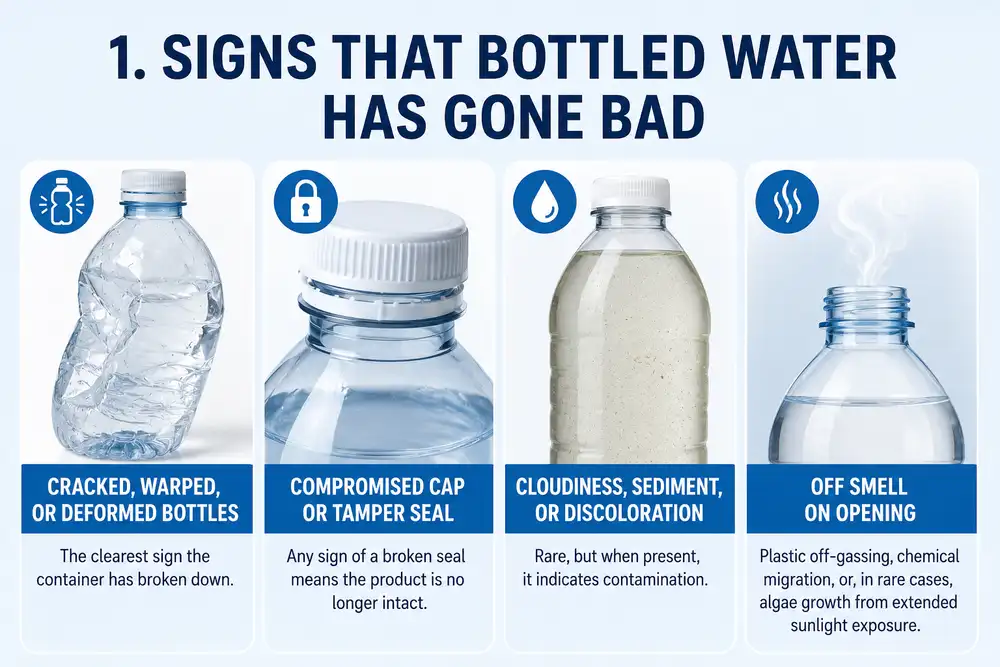
In most cases, out-of-date bottled water will look and smell completely normal. The degradation happening inside a PET bottle is largely invisible. But there are visible signals that a lot should be assessed before it moves anywhere:
- Cracked, warped, or deformed bottles – the clearest sign the container has broken down
- Compromised cap or tamper seal – any sign of a broken seal means the product is no longer intact
- Cloudiness, sediment, or discoloration – rare, but when present, it indicates contamination
- Off smell on opening – plastic off-gassing, chemical migration, or, in rare cases, algae growth from extended sunlight exposure
For palletized or warehoused inventory, the assessment needs to go beyond the individual bottle. If you cannot confirm that storage conditions were controlled throughout the product’s life: temperature, UV exposure, proximity to chemicals, treat the entire lot as suspect, not just the bottles showing visible signs. The ones that look fine may not be.
Storage Conditions That Accelerate Bottle Degradation
Not all storage environments are equal, and for water inventory, the gap between good and bad conditions is significant. The IBWA recommends storing bottled water at room temperature or cooler, out of direct sunlight, and away from solvents and chemicals. Here is what accelerates PET degradation most:
|
Condition |
Why it matters |
|
Heat above 70°F (21°C) |
The primary driver of antimony leaching and structural degradation; unventilated warehouses and loading docks in summer regularly exceed this threshold |
|
Direct UV and sunlight exposure |
Breaks down PET at a molecular level; extended sunlight exposure can also occasionally lead to algae or mold development |
|
Proximity to chemicals and solvents |
PET is slightly permeable; bottles stored near cleaning products or petroleum-based goods can absorb odors and trace compounds through the bottle wall (Consumer Reports, 2019) |
|
Heavy stacking pressure |
Long-term case stacking deforms bottles, stresses seals, and compromises integrity in ways that may not be visible until the pallet is broken down |
For 3PLs and distributors managing large water SKU volumes with long dwell times, these are not edge cases. FIFO rotation, climate-controlled storage, and keeping water inventory away from chemical storage areas are the three controls that matter most.
What Should Brands and Distributors Do with Out-of-Date Water Inventory?
Out-of-date bottled water is one of the most common unsaleable inventory scenarios for distributors, retailers, and beverage brands. Slow-moving SKUs, seasonal overstock, distributor relationship changes, and long dwell times in non-climate-controlled facilities all create accumulation. The options, in order of suitability depending on volume and condition:
- Donation: Some food banks and disaster relief organizations accept near-date or recently past-date sealed water. Confirm acceptance policies before committing reverse logistics resources to this option; not all organizations can take it, and volume thresholds vary significantly.
- Remarketing or liquidation: Viable only if the product is still within its quality window, and the brand owner permits redistribution. Once the printed date has passed, moving product through standard channels is typically off the table.
- Professional beverage destruction and recycling: The appropriate pathway when the product is past date and unsaleable, documentation is required, or volume is measured in pallets or truckloads. For plastic water bottles specifically, this is also where the environmental story changes: the water is disposed of responsibly, and the PET packaging is a recoverable material. A proper destruction program separates and recycles the packaging rather than sending full containers to the landfill.
Destruction is the right call when:
- The product cannot be legally or commercially redistributed.
- Your brand or a retail partner requires a certificate of destruction for compliance or audit purposes.
- Storage conditions were compromised and you cannot certify the product as intact.
- The volume is too large for donation or liquidation logistics to absorb.
For brands, distributors, and retailers managing out-of-date water at scale, our beverage destruction and recycling services cover the full process, from pickup and chain of custody through to responsible disposal and packaging recovery.
For multi-location pickups or large truckload volumes, beverage destruction logistics and pickup coordination is a separate part of the process; worth confirming with your provider before you commit.
Frequently Asked Questions
1. Does bottled water actually expire?
Water as a chemical compound does not expire. Manufacturers print dates to reflect quality standards and inventory tracking conventions, not a safety threshold. The FDA has confirmed that bottled water has an indefinite safety shelf life if produced correctly and stored in an unopened, sealed container, and does not require manufacturers to print an expiration date.
2. Why does bottled water have an expiration date?
Expiration dates on bottled water are set voluntarily by manufacturers, not mandated by the FDA. They serve inventory tracking, quality assurance, and multi-market labeling compliance purposes. New Jersey was the only U.S. state to ever require them by law, a requirement it repealed in 2006 after finding no scientific basis for it.
3. Does bottled water expire if unopened?
Unopened, properly stored bottled water is highly shelf-stable. The main degradation risk over time is the plastic bottle itself, particularly under heat or UV exposure, which can cause trace chemical migration into the water. For commercial purposes, a sealed product past its printed date is typically considered unsaleable even if not physically unsafe.
4. What happens to plastic water bottles over time?
PET plastic bottles degrade when exposed to heat, UV light, or prolonged storage. Research shows that heating PET bottles to 50 degrees Celsius can push antimony concentrations above the USEPA safety threshold in as little as 24 hours – a real concern for product stored in non-climate-controlled warehouse environments. Structurally, bottles also weaken, warp, and become more permeable over time.
5. What should I do with large quantities of expired bottled water?
For brands, distributors, or retailers with significant volumes of out-of-date water inventory, the most practical options are donation (where accepted) or professional beverage destruction with packaging recycling. A documented destruction process provides a certificate of destruction for compliance and audit records and ensures the PET packaging is properly recovered rather than landfilled.
Managing expired, recalled, or unsaleable beverage inventory? Brands, distributors, and retailers across the country work with BeverageDestruction.com to handle product that can no longer be sold. See how our beverage destruction and recycling services can help.