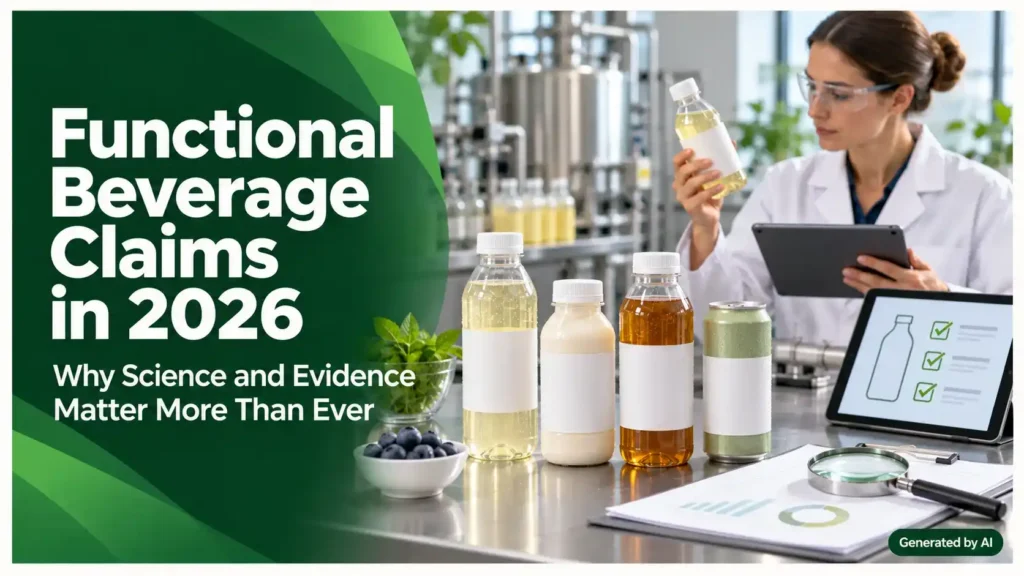
Functional beverage claims tell shoppers that a drink supports a body function or health outcome beyond basic nutrition, such as energy or gut health. In 2026, shoppers keep asking for proof, and courts and advertising reviewers do too. They want evidence for the finished drink, at the dose it actually contains.
So how many people does this touch? The EY Consumer Beverage Survey found that 65% of its 2,512 adults in the U.S. and Brazil drink functional beverages at least every two weeks (fielded November to December 2025). Meanwhile, Attest research on functional beverages found that 73% of U.S. consumers want clinical research behind functional claims. Attest polled 2,000 working age consumers in the U.S. and UK. That gap between habit and proof is where functional beverage science now matters most to you.
In this article, we’ll look at what counts as a functional claim and why evidence matters more this year. We’ll also cover how dose and formulation shape the science, and what helps you earn trust with shoppers.
What Are Functional Beverage Claims, Exactly?
Before we get into the evidence, it helps to agree on terms. FDA’s claim categories start with health claims, which link a food to a lower risk of disease and need FDA authorization. Then come nutrient content claims, which describe how much of something a product contains, like “high in protein” or “low sugar.”
The third group is where most claims on functional drinks live. Structure/function claims describe an effect on the body, such as “supports immunity” or “helps you relax.” According to FDA guidance on structure/function claims, which was current as of March 28, 2024, conventional foods need no FDA notification and no disclaimer for these claims. In plain terms, they can reach the shelf without FDA review.
So who checks them? Often that happens after launch, which puts the burden of proof on you.
Note: This article gives context rather than legal advice, so bring in your regulatory and legal advisers before you finalize any claim.
Why Evidence Matters More for Functional Drinks in 2026
Functional drinks have gone mainstream, and the people buying them are paying closer attention to what the label says.
Shoppers Are Asking for Proof
Attest found that 73% of U.S. consumers want clinical research behind functional claims and that figure rises to 78% among regular drinkers.
Ingredients matter to them too. In its March 2026 survey, EY found that 58% of U.S. consumers pay attention to ingredients, and 52% say they would pay more for drinks that support their health and wellness goals. When shoppers pay a premium, they expect the benefit to be real, and consumer trust can drop quickly if it is not.
More Claims Can Mean Less Trust
You might assume that more claims on the pack win more shoppers. The data points the other way. Mintel data reported by BeverageDaily shows that 47% of U.S. adults feel overwhelmed by the functional beverage assortment, and 57% prefer drinks that make fewer health or functional claims. Among 18- to 24-year-olds, those figures climb to 56% and 64%.
The doubt shows up in the UK as well. In Vypr research among UK consumers, many people saw functional claims as “just marketing.” Under 10% of those surveyed said they would buy based on influencer input.
Crowded shelves show up in Europe too. Mintel found health function claims on 27% of European launches in milk, drinking yoghurt, cultured milk and dairy alternatives in the year to September 2026, up from 17% in 2023.
Beverage Health Claims Under Scrutiny in Courts and Advertising Review
Shopper doubt rarely stays at the shelf. It also reaches the courtroom and the advertising review process, where brands now have to defend what they put on the pack.
Class Actions Focus on Dose
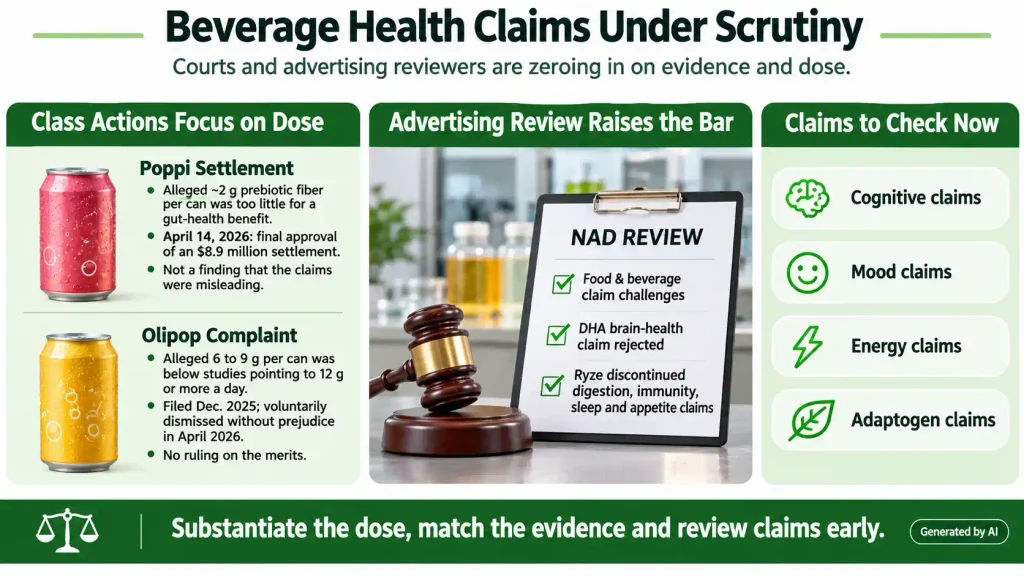
Two prebiotic soda cases show the pattern, and in both the allegations never became findings. On April 14, 2026, a federal court granted final approval of the Poppi settlement, an $8.9 million deal (Cobbs v. VNGR Beverage, N.D. Cal.). Plaintiffs alleged that about 2 g of prebiotic fiber per can was too little for a meaningful gut health benefit. Poppi did not admit wrongdoing, and the settlement is not a finding that the claims were misleading.
The Olipop complaint, later dismissed, was filed in December 2025 in the Eastern District of New York (Somers v. Olipop). It alleged that 6 to 9 g per can was not enough, citing studies pointing to 12 g or more a day. The plaintiff voluntarily dismissed the case without prejudice in April 2026, before any ruling on the merits.
Both cases centered on the amount in the can and whether it matched the research. One case ended in a settlement and the other was withdrawn, yet both show the dose argument plaintiffs bring. That is a useful reminder that beverage health claims can face pressure straight from the shoppers who buy the drink.
Advertising Review Raises the Bar
The National Advertising Division (NAD), the advertising industry’s own review body, heard at least four food and beverage claim challenges in 2025, according to FoodNavigator on NAD’s 2025 food and beverage decisions. In one decision, NAD rejected a “promotes brain health” claim because the DHA amount sat below the amount in the supporting studies. After a challenge, Ryze discontinued claims about digestion, immunity, sleep and appetite.
FoodNavigator expects cognitive, mood, energy and adaptogen claims to face scrutiny next. If your pack makes one of those, it may be worth checking your evidence now.
Functional Beverage Science and the Gap Between Ingredient and Finished Drink
Once someone challenges a claim, the conversation quickly turns to what counts as proof. That is where the gap between ingredient research and your finished drink starts to matter. 7/h3
What Counts as Competent and Reliable Evidence
The FTC Health Products Compliance Guidance applies to any health-related product, and that includes drinks. It says health benefit claims need “competent and reliable scientific evidence.” Generally, that means randomized, controlled human trials. The FTC also looks at the whole body of research, so one encouraging study rarely settles the matter.
Why Dose and Formulation Matter
The same guidance asks advertisers how the dosage and formulation of their product compare with the product that was studied. That question sits underneath everything we covered above. The NAD’s DHA decision and both prebiotic cases centered on that gap.
Here is an example. A study on one of your functional ingredients in a capsule, or at a higher dose, does not automatically support a claim for a drink with less of it. Research on functional ingredients shows what may be possible at a given amount. Your evidence for the finished drink shows what you can say on the pack.
Delivery Is Part of the Evidence
A 2025 Nutrients editorial on functional foods and beverages points to gaps in turning promising research into real-world benefits. It also notes that many bioactives have low bioavailability. A Slovenian study of 50 vitamin-fortified beverages, summarized in that editorial, found that 48.4% of the vitamin measurements assessed fell outside the EU’s accepted tolerance range.
To be on the safe side, ensure that what the label says matches what is in the drink across its whole shelf life.
How Brands Build Beverage Consumer Trust
So what do brands that earn trust do differently? Four habits stand out from the sources above.
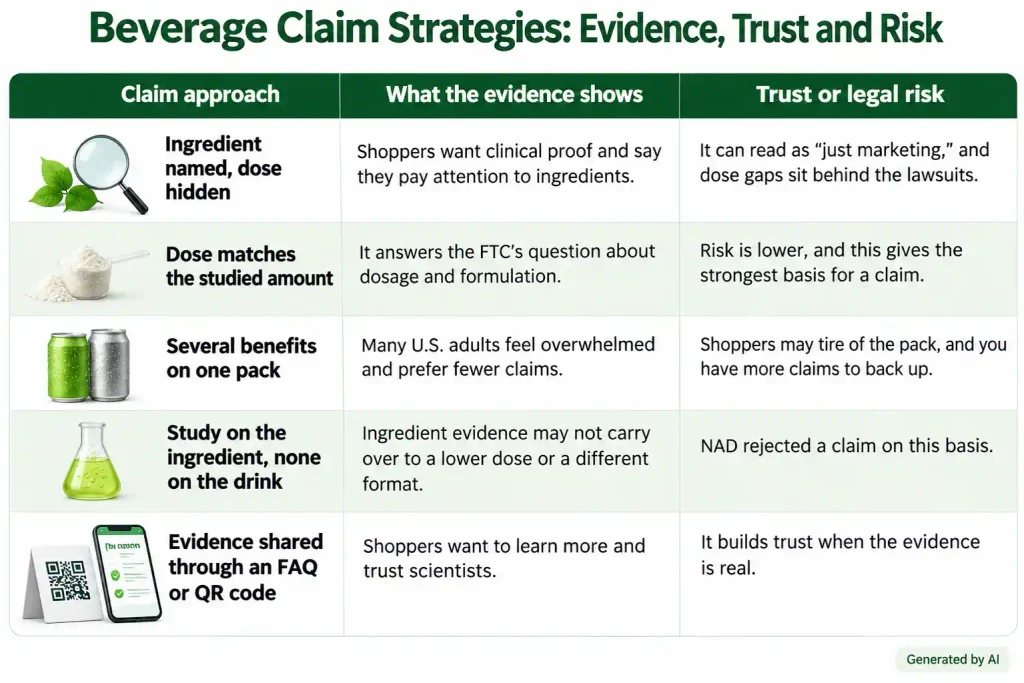
- First, they lead with fewer, clearer claims. Given the claims fatigue in the Mintel data, one benefit the evidence supports usually reads better than a pack full of promises.
- Second, they show the dose. FoodNavigator’s August 2026 piece on whether functional drinks can prove their claims quotes a marketing consultant and an IP lawyer on disclosing doses and sourcing.
- Third, they point to the evidence. Mintel’s Alex Beckett suggests linking studies or summaries through a website FAQ or a QR code on the pack.
- Fourth, they bring in trusted voices. In the 2025 Edelman Trust Barometer report, 73% of respondents across 28 markets said they trust the food and beverage industry to do what is right. Skepticism still runs deeper around nutrition claims. The report calls it especially pronounced and recommends scientists and health institutions as outside voices.
Taste still draws people in first, according to Vypr’s research among UK consumers, so none of this replaces a drink people enjoy. But when you want lasting beverage consumer trust, these habits give shoppers a reason to believe you.
Evidence-Based Beverage Claims at a Glance
Use this summary table as a quick check on where your own claims sit.
What Claim Decisions Mean for Production and Retail
Claims are product decisions as much as marketing ones, and that shows up on the line and on the shelf. For food and beverage manufacturers, a claim that has to change or come off the pack means new labels, and that is how teams end up with obsolete beverage labels. A claim that buyers or shoppers do not believe is a launch risk, and a failed beverage launch can follow. And of course, raising an ingredient dose to match the evidence is a beverage reformulation, which needs its own planning. We mention these because a claim choice often travels further down the chain than a team expects.
Where Does This Leave Your Brand?
Functional beverage claims now win on evidence and on openness about dose. Evidence-based beverage claims work as both a trust strategy and a risk strategy. If you manage changing claims and products, our beverage brand and retailer solutions show how we support that side of the work. And if you would like to talk it through, contact us.
Frequently Asked Questions
Do functional beverage claims need FDA approval?
Health claims need FDA authorization. Structure/function claims on conventional foods need no FDA approval or notification, but they cannot be false or misleading. The FTC also expects scientific evidence behind them, so your evidence matters more than any approval stamp.
Why are functional beverage brands facing lawsuits?
Recent cases have alleged that the dose in the can is too low to deliver the claimed benefit. From the examples above, one ended in a settlement the court approved, and another was voluntarily dismissed. These are allegations rather than findings. The common thread is whether the dose matches the research.
Why does the dose of functional ingredients matter?
Evidence supports a benefit at the amount studied, and a smaller amount may not give the same result. That is why the FTC asks how your dosage and formulation compare with the product studied. Functional ingredients in a drink can differ from the same ones in a capsule.
How can a beverage brand show its claims are credible?
Start with fewer claims, state the dose, and share the evidence openly. A website FAQ or a QR code on the pack gives shoppers somewhere to check for themselves. We also recommend regulatory and legal review before you launch a claim.