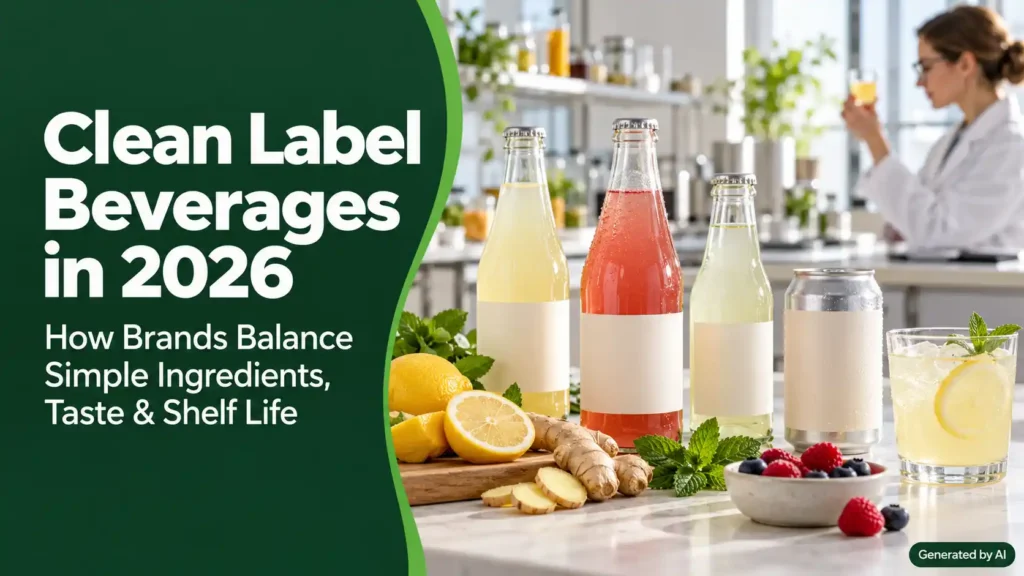
Clean label beverages are drinks made with fewer ingredients that shoppers recognize, and the idea sounds simple until you start taking things out. Every ingredient you remove can change how a drink tastes and how long it stays good on the shelf, so most of the real work happens in that balance.
The IFIC 2025 Food & Health Survey, which polled 3,000 American adults from March 13 to 27, 2025, found that 25% name limited or no artificial ingredients or preservatives as a mark of a healthy food. That figure describes how Americans judge food in general, so we would not read it as a measure of demand for clean label drinks.
Since that survey only tells part of the story, we look below at what clean label really means and what the FDA has said about common label claims. From there, we cover how taste and shelf life, including natural preservatives, shape formulation choices, and what those choices mean for production and retail.
What Are Clean Label Beverages?
A clean label drink has a short ingredient list full of items a shopper would recognize. Beyond that, things get fuzzy, because researchers still have no common, objective definition of clean label, so one brand’s version may look quite different from another’s.
In the broad sense, shoppers judge a product by assumption and by what the front of the pack tells them. In the strict sense, they turn the bottle around and read the ingredient list on the back. That difference matters, because a clean claim up front may earn a first look while the back label decides whether the product holds up.
Some shoppers search for clear label beverages instead, and what they usually want is beverage label transparency, meaning a label that says plainly what is inside. And of course, claims shift as rules and expectations do, which is one reason brands sometimes end up dealing with obsolete beverage labels later on.
What Shoppers Look For and What Brands Can Claim
Before we get into formulation, it helps to know what shoppers say they look for and what the FDA has said about common label claims.
1. What Shoppers Look For
Let’s start with what Americans say makes a food healthy. In the IFIC survey, 34% chose low in sugar and 24% chose natural, alongside the artificial ingredient answer covered earlier. Protein (38%) and fresh (36%) lead the list, though, so simple ingredients are one of several factors.
These are food wide numbers, so they are not proof of demand for any single drink. However, they do help explain current beverage formulation trends, since brands may be weighing sugar and ingredient lists together. Shoppers who lean toward natural beverage ingredients may notice simple ingredient beverages on the shelf, although noticing a bottle and buying it are two different things.
2. What “No Artificial Colors” Can and Cannot Claim
In a letter dated February 5, 2026, the FDA says it will not pursue enforcement over three claim wordings on foods that contain no FD&C certified colors. Those wordings are “Made without artificial food colors/colorings”, “No artificial color/colors/coloring” and “No added artificial color/colors/coloring”.
Colors derived from natural sources still need FDA premarket approval through its color additive petition process. The agency presents this as its enforcement position and not as a new rule.
3. The Natural Claim and What the FDA Has Said
The FDA has not engaged in rulemaking to define “natural”. Its policy treats the term as meaning that nothing artificial or synthetic has been added that would not normally be expected in the food. The policy (last updated October 22, 2018) is also separate from any definition of clean label, and it does not explicitly address production or processing methods such as pesticide use and pasteurization.
Taste and Keeping Flavor When Ingredients Come Out
Take an ingredient out and you change more than the list. Taste and texture can shift too, sometimes in ways a team only notices after several tasting rounds.
1. Taste Still Decides the Purchase
According to the IFIC survey, taste has been the top food and beverage purchase driver since 2006, and for 20 consecutive years Americans have rated it above price, and above healthfulness and convenience too. A shorter label may get someone to pick up the bottle, but it cannot make up for a drink that tastes worse.
2. When Natural Preservatives Change the Flavor
Adding natural antimicrobials can influence the sensory properties of a food, and high concentrations risk undesirable flavor changes. Brands therefore weigh the dose against the flavor. So the real question is how much protection you can add before the drink starts to taste different.
Shelf Life and Reducing or Replacing Artificial Preservatives
Shelf life is where a simple recipe gets tested hardest. Here we look at how natur
al preservatives and processing each hold up, and where each approach fits best.
1. Why Shelf Life Is the Hardest Balance to Strike
The antibacterial activity of natural preservatives may decrease after storage, and transport and storage may call for higher concentrations than laboratory tests used. Activity also depends on the microorganism, the inoculum size, and the plant source, harvest time and stage of development. In other words, a recipe can pass a lab test and still fall short in distribution.
2. What Natural Preservatives Can and Cannot Do
Plant extracts and essential oils, along with organic acids, are among the natural options the Teshome et al. review describes, yet only a limited number of natural antimicrobial and antioxidant compounds are used commercially, because they cost more than chemical preservatives. Consumers also want synthetic preservatives partly or completely removed, but that can change the flavor.
3. High Pressure Processing as an Alternative
One example comes from a 2023 test of high-pressure processing on carrot juice. The juice was treated at 600 MPa for 3 minutes at 20 °C and showed no detectable microbes through 15 days at 4 °C, while blanched juice without it had a refrigerated shelf life of only 6 days.
Keep the limits in view, though. The study compared high pressure processing with blanching and not with preservatives, it ended at day 15, it covered one juice, and it kept samples at 4 °C. This is just one processing option for chilled drinks rather than proof that it replaces preservatives.
4. Chilled or Ambient and Where Each Approach Fits
Natural preservatives may lose activity in storage, so a drink meant for ambient shelves faces the harder test. That’s why you should decide the storage route before choosing the approach.
It also helps to separate two things. Formulation and processing decide how long a drink stays safe and stable, while packaging and storage affect its quality over time, a gap that helps explain why bottled water still carries an expiration date.
How Brands Weigh the Competing Priorities
By now you can probably see how these pieces pull against each other. Here is how that plays out in practice.
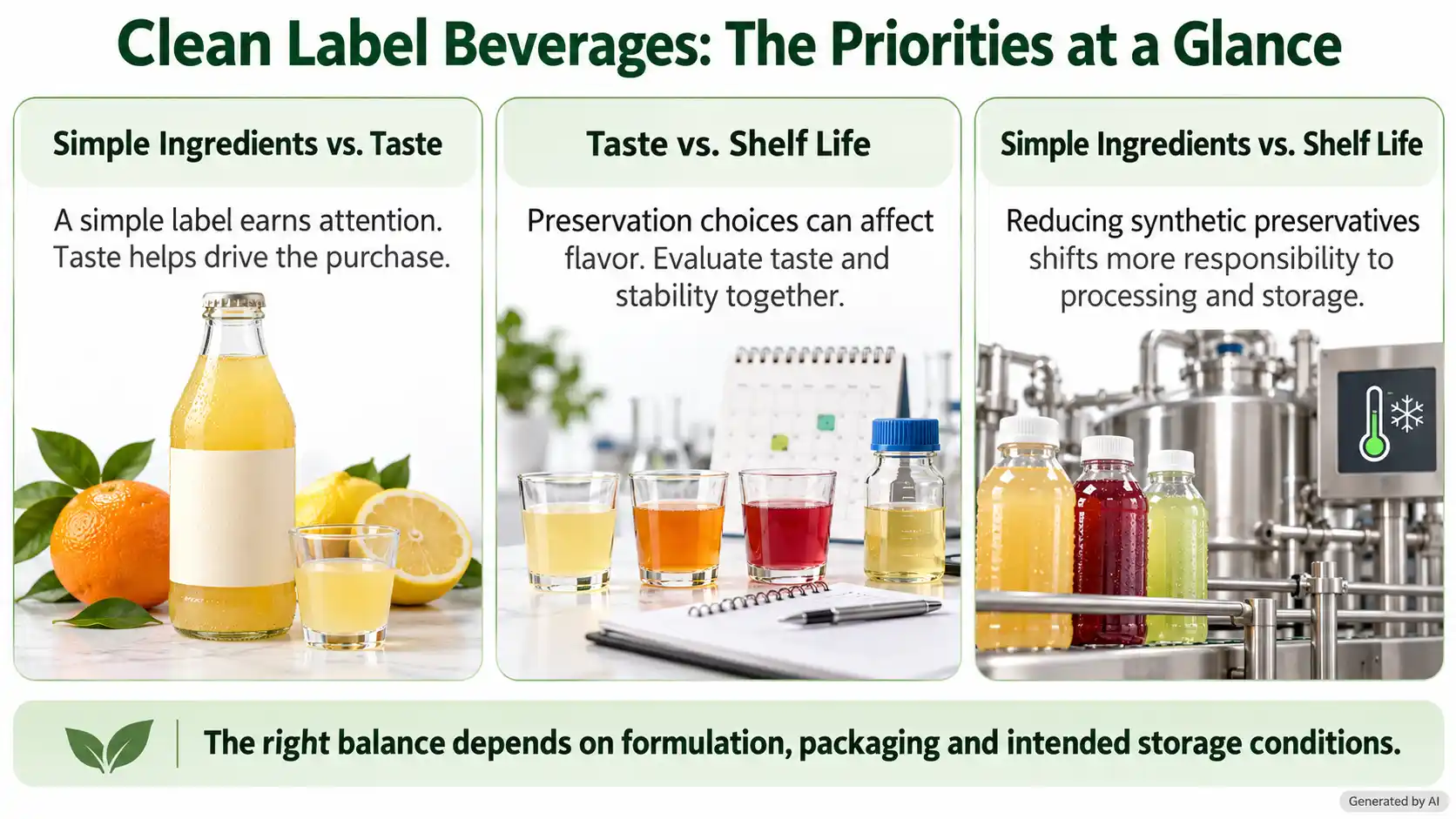
1. Simple Ingredients versus Taste
Shopper interest in fewer artificial ingredients sits next to taste, the strongest purchase driver. A simple label earns a look, and taste drives the purchase.
2. Taste versus Shelf Life
Natural preservatives may require higher concentrations to maintain effectiveness during storage, but those concentrations can also affect flavor. Brands therefore need to evaluate preservation and taste together for each formulation.
3. Simple Ingredients versus Shelf Life
Reducing synthetic preservatives shifts more of the preservation requirements to processing and storage. The appropriate approach depends on the beverage’s composition, packaging, and intended storage conditions.
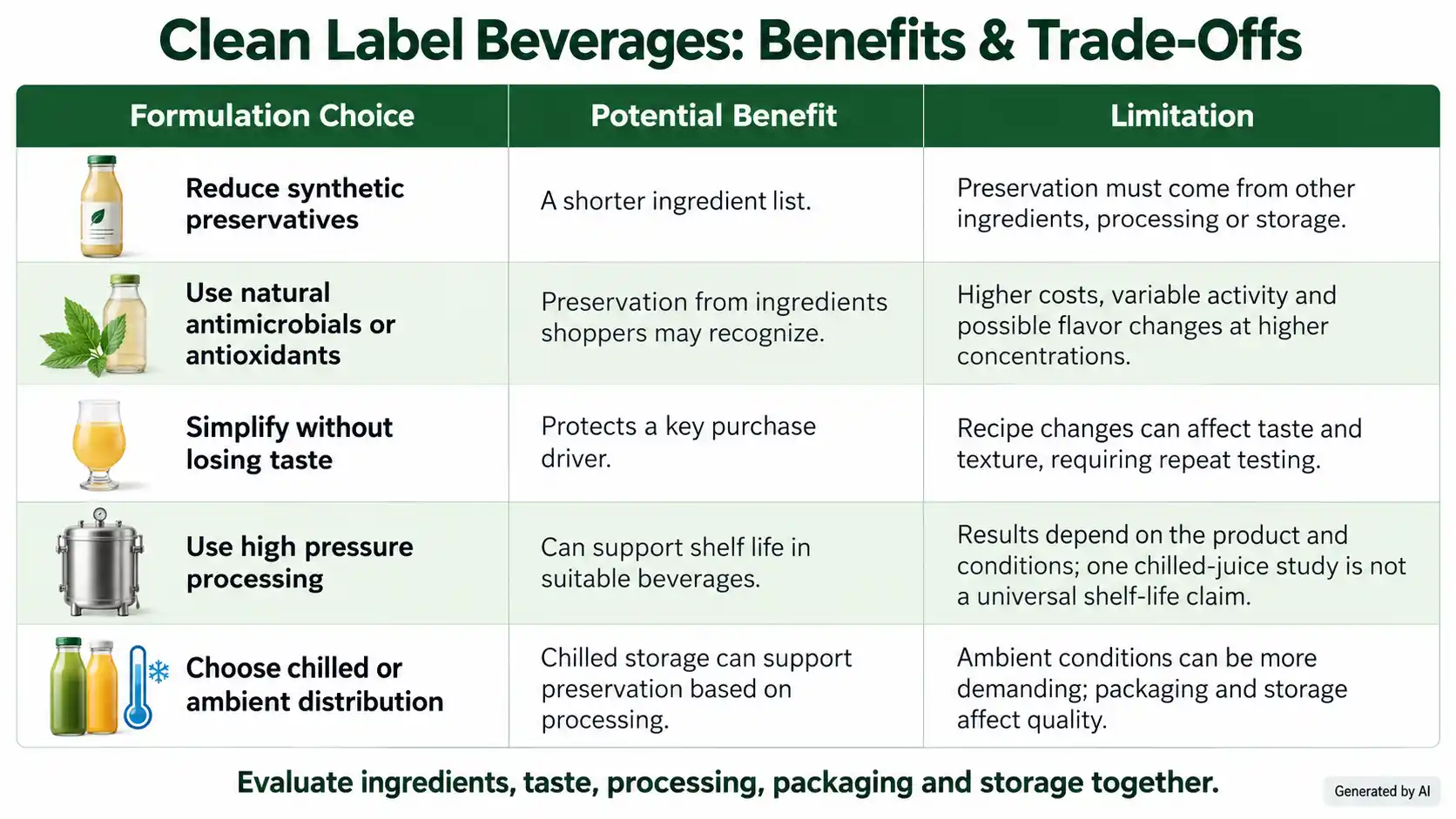
4. The Priorities at a Glance
|
Formulation Consideration |
Potential Benefit |
Limitation |
|
Reducing or removing synthetic preservatives |
A shorter ingredient list. The IFIC 2025 survey found 25% of American adults use limited or no artificial ingredients or preservatives to define a healthy food in general. |
Shelf life has to come from other ingredients, processing or storage. |
|
Replacing them with natural antimicrobials or antioxidants |
Preservation from ingredients shoppers may recognize. |
They cost more, their activity varies and may decrease in storage, and high concentrations can change the flavor. |
|
Keeping taste while simplifying the recipe |
Protects taste, which the IFIC survey shows has led purchase decisions every year since 2006. |
Removing an ingredient changes taste and texture, so the recipe may need rework and repeat taste testing. |
|
Using processing such as high pressure processing |
In one study, carrot juice showed no detectable microbes through 15 days at 4 °C, against 6 days for blanched juice. |
That was one chilled juice compared with blanching rather than preservatives, and it was tested only to day 15. |
|
Choosing chilled or ambient distribution |
Chilled storage supports a shelf life built on processing. |
Ambient shelves are the harder test for a drink with fewer preservatives, and packaging and storage still affect quality over time. |
How Do Clean Label Choices Affect Beverage Production and Retail?
On the production side, a shorter or chilled shelf life changes how you plan batches and how long finished product can wait before it ships. That said, test shelf life under real storage conditions with taste checks, since natural preservatives may lose activity over time.
Chilled drinks need cold storage all the way to the shelf, and it is worth checking each retailer’s requirement for remaining shelf life at delivery. If you work with beverage brands and retail partners, you know how much that date can matter. And of course, a formula change leaves old formula stock to plan for, and that leftover stock is a common source of beverage reformulation waste.
Clear label drinks ask you to balance a short ingredient list against taste and shelf life, and the right answer often depends on where your drink will be stored. If you want to talk through the production side of those choices, take a look at our food and beverage manufacturing solutions or simply contact us.
Frequently Asked Questions
There is no common, objective definition. Generally, the term points to fewer ingredients that shoppers recognize, judged either broadly from the front of the pack or strictly from the ingredient list.
Plant extracts and essential oils, along with organic acids and naturally occurring polymers such as chitosan, are used as natural preservatives across the food industry. These are potential formulation options rather than ingredients suited to every beverage, since their use depends on the product and how it is processed, as well as on sensory impact and applicable regulations. Only a limited number of natural antimicrobial and antioxidant compounds are used commercially, since they cost more than chemical preservatives.
Brands generally combine natural preservatives, processing and the right storage route. In one study, high pressure processing kept carrot juice free of detectable microbes through 15 days at 4 °C, though that covers one chilled juice.
It depends. Their activity varies with the microorganism and plant source, may decrease in storage, and can call for higher concentrations that affect flavor.