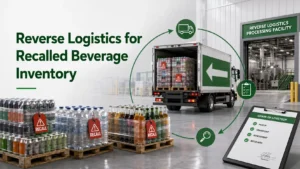
Every year, breweries, wineries, distilleries, and RTD brands end up holding product they can no longer sell: batches that missed spec, cases that expired on the shelf, inventory pulled in a recall. Most of that alcohol still holds real value.
Ethanol recovery, also known in the industry as ethanol reclamation, is the process that turns unsaleable beverages into usable ethanol instead of a landfill or wastewater liability.
Not every batch qualifies, though. Federal alcohol regulation decides eligibility, not guesswork.
This guide walks through what ethanol recovery actually involves, which beverages qualify, and what happens once a batch gets accepted.
What Ethanol Recovery Actually Means
Ethanol recovery (also known as ethanol reclamation) is the process of reclaiming pure ethanol from beverages that can no longer be sold. A licensed provider collects the unsaleable stock, destroys it under controlled conditions so it can never be resold or diverted, then separates the ethanol out through distillation and filtration.
Every step of the process gets documented as it happens. The controlled destruction stage in particular is recorded on a certificate of destruction, a formal document confirming that the product has been permanently destroyed and cannot be resold, reused, or otherwise returned to circulation.
Recover Value from Unsaleable Alcohol Instead of Writing It Off
Dumping alcohol-containing product into a drain or landfill is rarely as simple as it sounds. Liquid waste with alcohol content carries its own disposal costs, regulatory paperwork, and environmental liability when handled incorrectly. Treating an entire batch as a total loss also ignores the fact that the ethanol inside it still has commercial value once separated from the beverage.
That’s where recovery comes in, making an appealing business case. This process converts a write-off into a byproduct sold into fuel, industrial, or chemical markets, and it is the compliant route for any product containing alcohol that can no longer be sold as a beverage.
Additionally, landfill exposure from unsaleable beverage inventory drops the moment recovery replaces disposal as the default, which is the core idea behind most companies pursuing this strategy today.
Which Unsaleable Beverages Qualify for Ethanol Recovery?
This is the question that actually matters. Not all unsaleable beverages are a fit, but you can easily check their eligibility.
1. Step-by-Step: How to Know if Your Product Qualifies
Qualifying for ethanol recovery comes down to the following steps:
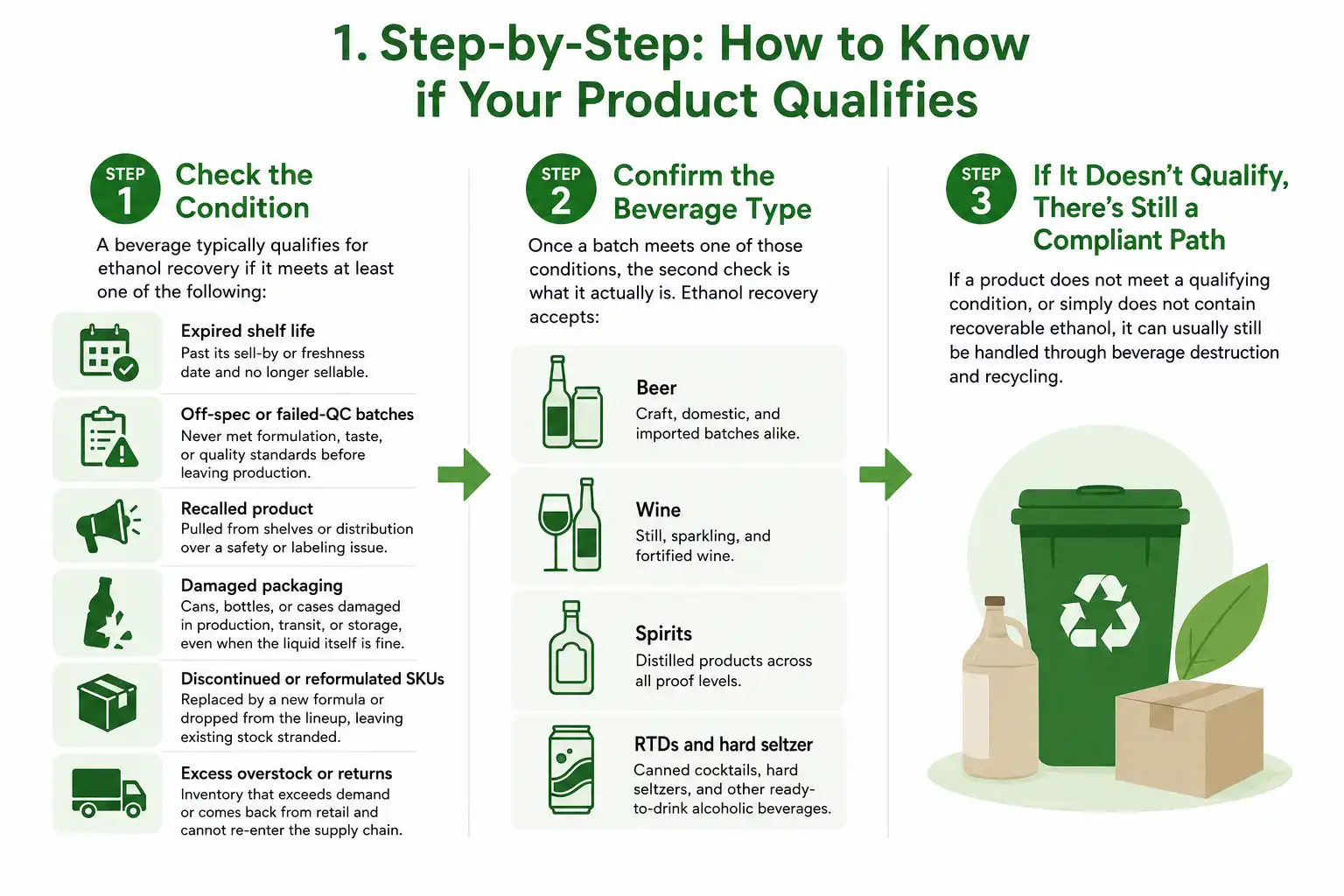
Step 1: Check the Condition
A beverage typically qualifies for ethanol recovery if it meets at least one of the following:
- Expired shelf life: past its sell-by or freshness date and no longer sellable.
- Off-spec or failed-QC batches: never met formulation, taste, or quality standards before leaving production.
- Recalled product: pulled from shelves or distribution over a safety or labeling issue.
- Damaged packaging: cans, bottles, or cases damaged in production, transit, or storage, even when the liquid itself is fine.
- Discontinued or reformulated SKUs: replaced by a new formula or dropped from the lineup, leaving existing stock stranded.
- Excess overstock or returns: inventory that exceeds demand or comes back from retail and cannot re-enter the supply chain.
Step 2: Confirm the Beverage Type
Once a batch meets one of those conditions, the second check is what it actually is. Ethanol recovery accepts:
- Beer: craft, domestic, and imported batches alike.
- Wine: still, sparkling, and fortified wine.
- Spirits: distilled products across all proof levels.
- RTDs and hard seltzer: canned cocktails, hard seltzers, and other ready-to-drink alcoholic beverages.
Step 3: If It Doesn’t Qualify, There’s Still a Compliant Path
If a product does not meet a qualifying condition, or simply does not contain recoverable ethanol, it can usually still be handled through beverage destruction and recycling instead. The two paths solve for the same underlying problem: unsaleable inventory that needs to leave the market permanently and compliantly.
2. Does Expired or Out-of-Code Product Qualify?
Expired-dated product, or out of code beverage products as the industry tends to call it, is one of the most common qualifying conditions a brand runs into. If a batch simply ran past its printed date and never sold through, it is very likely a candidate for recovery.
3. Do Non-Beverage Products Qualify Too?
Beverages are not the only ethanol-containing products in this conversation. Hand sanitizer, mouthwash, and fragrance can also be candidates for ethanol recovery, since they contain the same reclaimable alcohol.
4. What Temperature Does Ethanol Evaporate?
Ethanol boils at roughly 173°F (78°C), noticeably lower than water’s 212°F (100°C). That gap is exactly what makes distillation-based recovery possible: heating a batch to somewhere between those two points lets ethanol vaporize off while most of the water and other components stay behind, ready to be captured and purified separately.
How the Ethanol Recovery Process Works, Briefly
Once a batch qualifies, it moves through the following three stages.
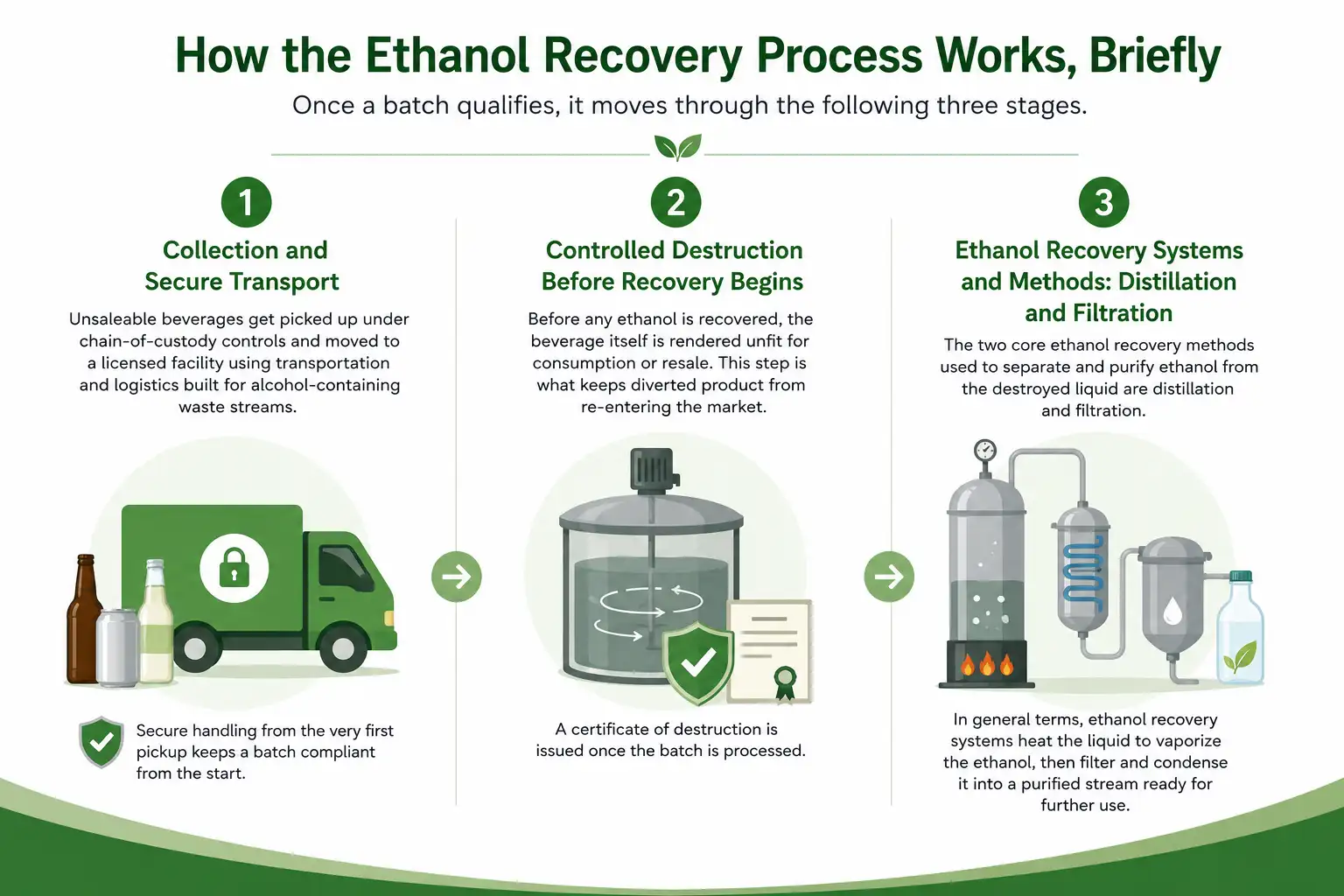
1. Collection and Secure Transport
Unsaleable beverages get picked up under chain-of-custody controls and moved to a licensed facility using transportation and logistics built for alcohol-containing waste streams. Secure handling from the very first pickup is what keeps a batch compliant from the start, rather than an afterthought.
2. Controlled Destruction Before Recovery Begins
Before any ethanol is recovered, the beverage itself is rendered unfit for consumption or resale. This step is what keeps diverted product from re-entering the market, and it is the reason a certificate of destruction gets issued once the batch is processed.
3. Ethanol Recovery Systems and Methods: Distillation and Filtration
The two core ethanol recovery methods used to separate and purify ethanol from the destroyed liquid are distillation and filtration. In general terms, ethanol recovery systems heat the liquid to vaporize the ethanol, then filter and condense it into a purified stream ready for further use.
What Happens to Recovered Ethanol?
Recovered ethanol does not go to waste once it is pulled out of a destroyed batch. Common end uses include fuel-grade ethanol for gasoline blending, industrial solvents, and chemical feedstock for manufacturing processes that need pure ethanol as an input.
This is where the sustainability case comes together. Alcohol recycling to fuel and other industrial applications mean waste-derived ethanol displaces material that would otherwise come from virgin or fossil sources. A batch headed for a landfill instead becomes a usable input elsewhere in the economy, a meaningfully different outcome for a brand’s environmental reporting than a straightforward disposal line item.
Why Ethanol Recovery Has to Go Through a Licensed Provider
Alcohol is one of the more heavily regulated materials a brand will ever need to dispose of. The TTB requires a DSP or BWC license to legally handle beverage alcohol destined for recovery. The EPA governs how the resulting liquid waste and byproducts are managed, the DOT sets the rules for moving alcohol-containing material between facilities, and Customs and DHS get involved when imported product is part of the batch. None of this is optional paperwork; it determines whether a product qualifies at all and how it has to be handled from pickup through final documentation.
Working with a provider that operates across the alcoholic beverage industry under this full regulatory stack keeps a brand’s compliance record clean, rather than exposed to a provider cutting corners on licensing.
1. What About Recalled Product?
Recalled product carries its own documentation trail on top of the standard recovery paperwork, since the recall itself has to be reported and reconciled with regulators separately. If a batch headed for ethanol recovery is also part of an active recall, keeping the beverage recall documentation and the recovery records aligned is what closes the loop cleanly on both fronts.
Find Out if Your Product Qualifies
Figuring out whether a batch or SKU qualifies comes down to its condition and its beverage type, and both are usually easy to confirm once someone looks at the inventory in question.
Our team handles ethanol recovery and reclamation for beverage brands sitting on expired, off-spec, recalled, or otherwise unsaleable product, operating as a licensed provider under TTB oversight. If a product turns out not to qualify, beverage destruction and recycling remains the compliant alternative.
The fastest way to know for certain is to get in touch with details on the specific batch or SKU.
Frequently Asked Questions
1. What is ethanol recovery?
Ethanol recovery reclaims usable ethanol from beverages that can no longer be sold, through controlled destruction followed by distillation and filtration. It gives brands a compliant, value-recovering alternative to landfill disposal.
2. What is the difference between ethanol recovery and ethanol reclamation?
There is no practical difference. Ethanol reclamation is simply the industry synonym for ethanol recovery, and brands, regulators, and providers use both terms to describe the same process.
3. What temperature does ethanol evaporate?
Ethanol boils at approximately 173°F (78°C), well below water’s 212°F (100°C). That temperature gap is what allows distillation to separate ethanol from the rest of a beverage.
4. What methods are used in ethanol recovery?
Distillation and filtration are the two primary methods. Distillation heats the liquid to vaporize the ethanol, and filtration purifies the resulting stream before it is put to further use.
5. Is ethanol recovery the same as beverage destruction?
No. Beverage destruction renders a product unfit for consumption or resale, and that step happens before ethanol recovery begins. Recovery is what happens next, when the ethanol is separated out of the destroyed liquid rather than the batch simply being disposed of.
6. Do I need a licensed provider for ethanol recovery?
Yes. Handling beverage alcohol for recovery requires a DSP or BWC license under TTB oversight, along with compliance with EPA, DOT, and, for imported product, Customs and DHS requirements. An unlicensed provider cannot legally process a qualifying batch.