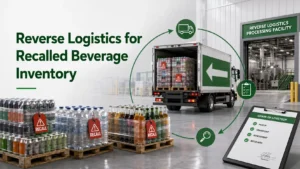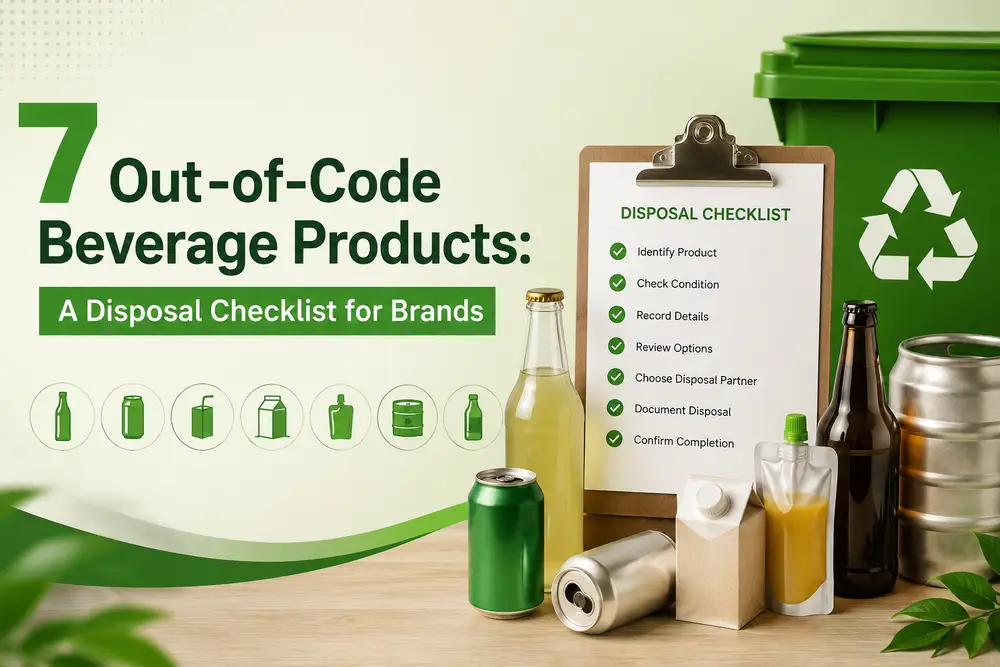
Three pallets flagged, date codes rolled, and a clock running on storage costs that cause audit risk and brand exposure. The question isn’t just what do we do with this — it’s what are we actually allowed to do, and what does it cost us to get it wrong.
Out-of-date beverage disposal isn’t a single decision. Different product types carry different regulatory frameworks, different hazards, and different recovery options.
This guide covers 7 beverage types followed by an 8-step checklist your team can actually use for moving unsaleable beverage inventory compliantly, efficiently, and without leaving recoverable value on the table.
What “Out-of-Code” Means for Brands and Retailers
Out-of-code beverages is a broader category than most teams realize. It includes product past its date code or best-by window but also inventory made unsaleable by a label fault, a co-pack error, a packaging change, or a discontinued SKU with nowhere left to go.
What every scenario has in common: this is a brand decision, not just a logistics one. Compliance, brand protection, and value recovery all have a seat at the table.
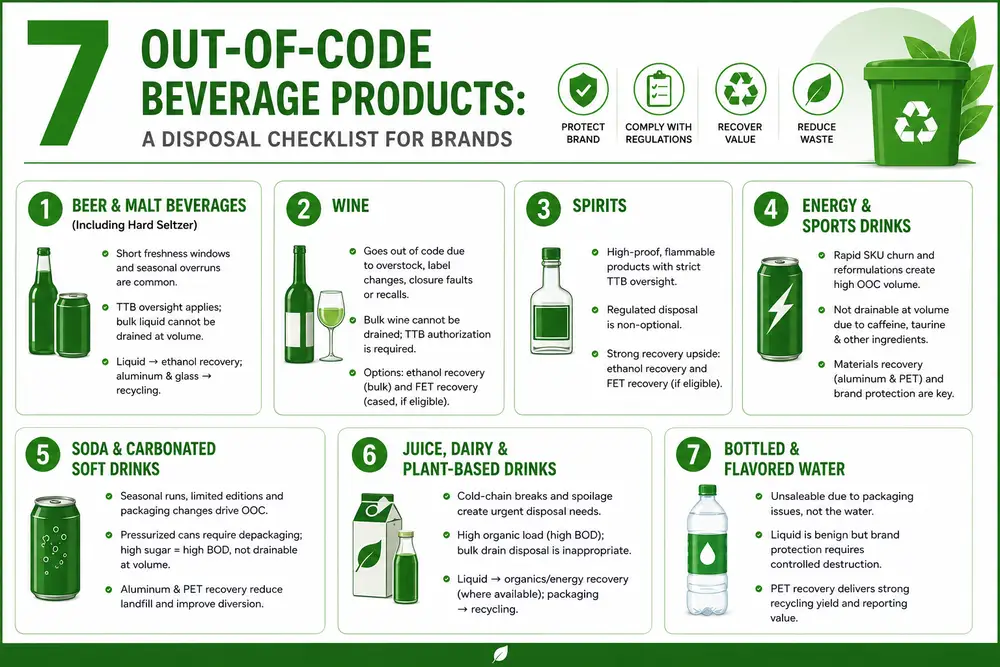
Two variables determine the disposal pathway: alcoholic vs. non-alcoholic, and packaged vs. bulk. Those splits define the regulatory obligations, recovery options, and documentation requirements beverage brands and retailers need at the end of the day. They’re also the framework behind the 7 beverage product types we cover in the sections below.
1. Beer & Malt Beverages (Including Hard Seltzer)
Beer, hard seltzer, and malt-based RTDs go out of code faster than almost anything else on this list. Short freshness windows, seasonal overruns, and mid-cycle label changes are routine.
The disposal requirements follow the alcohol content. Expired beverage disposal for beer falls under TTB oversight, and bulk liquid cannot be drained at commercial volume. BOD load and alcohol content put that outside wastewater rules in most jurisdictions. Full cans carry internal pressure and require proper depackaging to separate liquid from aluminum; bottles follow the same logic with glass.
As far as routing goes, liquid is usually sent for ethanol recovery while aluminum and glass enter material recovery streams.
Note: Federal requirements for alcohol disposal documentation for beer, wine and spirits are more specific than most teams expect and TTB compliance leaves little room for gaps.
2. Wine
Wine goes out of code for reasons beer rarely does:
- Vintage overstock
- Discontinued labels
- Closure faults
- Recall isolating a specific lot
Cased and bulk wine (both falling under TTB oversight) also follow completely different disposal paths.
Bulk wine cannot be drained at volume. The authorization requirement exists independently of environmental rules, and skipping it creates audit exposure. Glass-heavy cased wine also carries logistics weight worth factoring early.
Recovery options are stronger here than most brands realize: bulk wine qualifies for ethanol recovery, and cased wine that meets the threshold may be eligible for federal excise tax recovery.
3. Spirits
Spirits are the highest-stakes category on this list. High-proof alcohol is flammable, TTB oversight is strict, and the secondary-market value of discontinued or reformulated SKUs makes brand protection non-negotiable. Getting this wrong has operational, legal, and reputational consequences.
Regulated disposal isn’t optional here since flammability alone demands it, independent of compliance obligations.
The recovery upside is also the strongest of any category: ethanol recovery from high-proof spirits carries real commercial value, and qualifying cased product may be eligible for FET recovery through a certified partner.
4. Energy & Sports Drinks
Few categories generate unsaleable beverage inventory faster. Rapid SKU churn, constant reformulations, and aggressive new-launch cycles mean product regularly becomes unsaleable before it expires. Conventional date-code turnover adds to that volume.
The disposal complexity makes things even more complex. Caffeine, taurine, and other functional ingredients mean these aren’t casual drain pours at commercial volume. Additionally, PET and aluminum both require depackaging and material separation before either stream can be processed.
Recovery is primarily a materials story: aluminum and PET tonnage adds up fast in this category. Brand protection matters too as discontinued energy products have real gray-market appeal, and controlled destruction is the only reliable answer.
5. Soda & Carbonated Soft Drinks
Seasonal overruns, limited-edition runs, and mid-cycle packaging changes are the usual culprits, often leaving brands with full truckloads of product and a tight window to move it.
Two disposal realities define this category:
- Pressurized cans cannot be crushed or drained without controlled depackaging. Carbonation makes that non-negotiable.
- High-sugar liquids carry an elevated BOD load, which means bulk drain disposal creates a wastewater compliance issue at commercial volume. It’s one of the most underestimated hazards in how to dispose of expired beverages at scale.
When it comes to recovery, aluminum and PET both have value, and brands trying to reduce landfill exposure from unsaleable inventory will find this category moves the needle on diversion metrics.
6. Juice, Dairy & Plant-Based Drinks
This is the category where the clock runs fastest. Cold-chain breaks, spoilage, and short shelf-life SKUs make for the most time-sensitive unsaleable beverage products to manage. When a recall enters the picture, the window between identification and compliant disposal narrows quickly.
The disposal complexity is the organic load. Perishable liquids carry extremely high BOD, making bulk drain disposal inappropriate at any meaningful volume. Recycling beverage cartons and HDPE containers requires depackaging before either material stream can move forward.
Recovery follows two paths: organic or energy-recovery routes for the liquid where available, and carton, HDPE, and PET recovery for the packaging.
7. Bottled & Flavored Water
Bottled water rarely becomes unsaleable beverage inventory because the water itself is the problem. The issue is almost always the packaging: a label change, a co-pack error, a brand refresh that strands existing stock before it ships. The date stamp is typically a container requirement, not a safety signal (the full picture is in our does bottled water expire guide).
Disposal here is straightforward. The liquid is benign but brand protection still requires controlled destruction. If your label is on it, it needs a documented end.
PET recovery is the primary value path, and clean material separation makes the recycling yield measurable and reportable.
The Out-of-Code Beverage Disposal Checklist for Brands
A strong beverage brands disposal checklist does three things: protects the brand, satisfies the regulatory framework, and recovers whatever value remains. This 8-step checklist works across all product types:
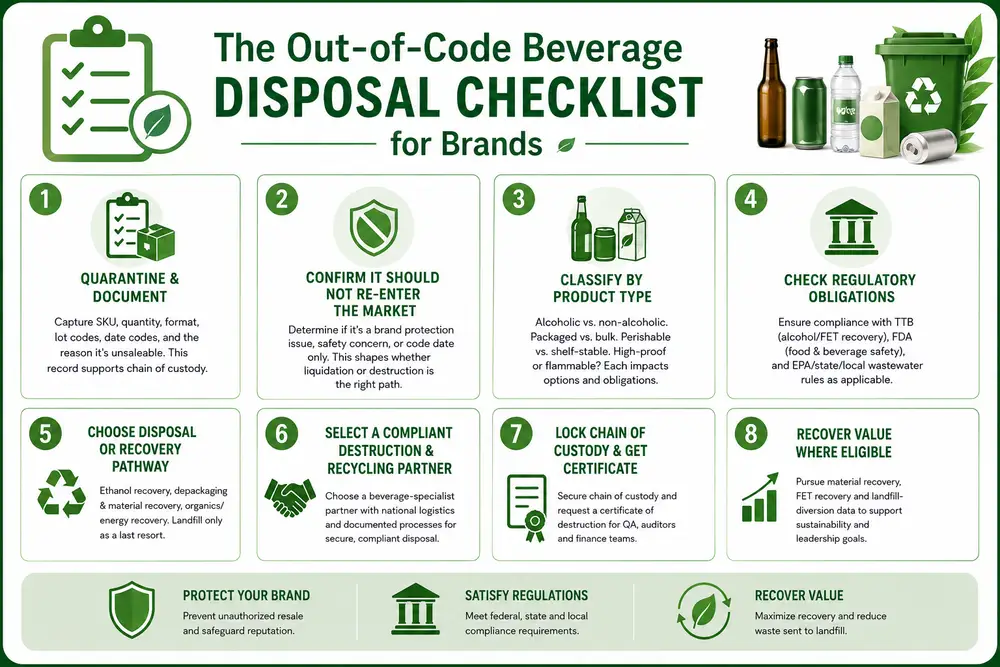
- Quarantine and document the inventory. Before anything moves, capture SKU, quantity, format, lot codes, date codes, and the specific reason the inventory is unsaleable. This record is the foundation of your chain of custody.
- Confirm it should not re-enter the market. Is this a brand-protection decision, a safety issue, or purely a code date? The answer shapes whether controlled secondary-channel liquidation is on the table, or whether destruction is the only path.
- Classify by product type. Alcoholic vs. non-alcoholic. Packaged vs. bulk. Perishable vs. shelf-stable. High-proof or flammable? Each variable affects your disposal options and your regulatory obligations.
- Check your regulatory obligations. This typically involves compliance with TTB for alcohol (and potential FET recovery), FDA for food and beverage safety, and EPA and state/local wastewater rules for any liquid being directed away from packaging.
- Choose your disposal or recovery pathway. Ethanol recovery for alcohol. Depackaging and material recovery for packaged product. Organics or energy recovery for perishable liquids. Landfill only as a documented last resort, never a default.
- Select a compliant beverage destruction and recycling partner. Beverage-specialist experience, national logistics capability, and documented processes matter here. Not all disposal vendors are equipped for beverage destruction and recycling at brand scale.
- Lock chain of custody and request a certificate of destruction. Your QA team, your auditors, and your finance team will all need this documentation.
- Recover value where eligible. Packaging material recovery, FET recovery on qualifying alcohol, and landfill-diversion data for sustainability and ESG reporting all make a managed disposal program defensible to leadership.
How to Choose a Beverage Disposal Partner
The right partner isn’t a generalist. Junk-removal vendors, waste haulers, and liquidation brokers each cover a slice but none owns the full scope that beverage brands and retailers actually need. Here’s what you need to look out for in a partner:
- Beverage specialization. Experience with alcoholic and non-alcoholic products, packaged and bulk, across multiple product types.
- National logistics capability. Multi-location brands and retailers need a partner who can coordinate pickup and processing across your whole distribution footprint.
- Documented chain of custody. From the moment product leaves your facility to final processing, you need a paper trail.
- Material and ethanol recovery. A destruction-only vendor leaves recovery value on the table. The right partner captures what’s recoverable.
- Compliance credentials. TTB, FDA, and EPA/state environmental; confirmed, not claimed.
- Product never re-enters channels. This is brand protection. It should be the partner’s operating standard, not a feature.
Powered by Skip Shapiro Enterprises, we operate specifically in this space, with national reach, beverage-specialist experience, and a documented process for beverage brands and retailers managing unsaleable, out-of-code, and recalled inventory at scale.
Out-of-Code Beverage Disposal: A Quick Reference
Seven product types, one principle: match the pathway to what you’re holding. Regulatory frameworks, recovery options, and brand-protection requirements all vary but the out-of-code beverage products disposal checklist above holds across all of them.
The bottom line: document it, classify it, handle it compliantly, and don’t leave recoverable value behind. Unsaleable beverage inventory is a liability only when it’s handled informally.
A managed beverage destruction and recycling program makes it a documented, value-recovering process.
Ready to move your inventory the right way? Contact us today to discuss your inventory situation.
FAQ
1. What does “out-of-code” mean for beverage products?
Out-of-code (or out-of-date) product has passed its date code or best-by window and can no longer move through primary sales channels. For brands and retailers, the definition extends further: overstock with nowhere to go, discontinued SKUs, and product affected by packaging or label faults that make it unsaleable.
2. Can we pour out-of-date drinks down the drain?
Not at commercial volume, and not without understanding what you’re disposing of. Sugary and organic liquids carry a high BOD load that creates wastewater compliance issues. Alcohol and any contaminated product trigger EPA and state-level environmental rules. Large-scale drain disposal is not a substitute for a managed disposal pathway.
3. What’s the difference between liquidating and destroying unsaleable inventory?
Liquidation moves product through controlled secondary channels. It still enters the market, just through a different path.
Destruction permanently removes product from any market channel.
The right choice depends on whether the product is safe and saleable in a secondary channel, and how much brand-protection risk your organization is willing to accept.
4. Do we need documentation when we destroy beverage inventory?
Yes. Chain-of-custody records and a certificate of destruction protect your organization in audits, recall investigations, and tax recovery processes. For alcohol, TTB compliance and FET recovery depend entirely on proper documentation.
5. Can we recover any value from out-of-code beverages?
Often, yes. PET, aluminum, and glass packaging all have recovery value. Alcohol can go to ethanol recovery. Qualifying alcohol may be eligible for federal excise tax recovery through a certified destruction partner. And landfill-diversion data from a managed program supports sustainability and ESG reporting.
6. Who is responsible for disposal — the brand, retailer, or distributor?
Generally, whoever owns the inventory at the point it becomes unsaleable bears responsibility for its compliant disposal. In practice, brands, retailers, and distributors often need to coordinate, especially when product has moved through the supply chain before the issue is identified.