A beverage recall moves fast, and from the moment it starts, every decision gets documented. Brands and distributors who have the right beverage recall documentation organized before anyone asks for it close recalls faster, with less liability exposure, and with supply chain relationships intact.
In 2024, there were 296 total food and beverage recalls across FDA and USDA, and while the total number slightly decreased from 2023, hospitalizations more than doubled, rising from 230 to 487, and deaths more than doubled, from 8 to 19 (FSNS, 2025). The recalls that close the fastest are the ones with documentation already in order.
This checklist covers what brands need to gather and maintain, what distributors are responsible for, and the single document that officially closes the recall record when everything else is done. It covers FDA-regulated non-alcohol beverages and TTB-regulated alcohol beverages; the two primary regulatory regimes in the beverage industry. Requirements vary by recall class and product type, so treat this as a framework and confirm specifics with your regulatory contact or legal counsel.
What Is a Beverage Recall? A Quick Framework Before the Checklist
Before getting into the documentation, it helps to know which regulatory body governs your product, because that determines what you are required to produce and when.
Who regulates what:
- FDA – regulates non-alcoholic beverages: water, juice, energy drinks, soft drinks, kombucha, and most other non-alcohol beverages
- TTB – regulates beverage alcohol: beer, wine, and distilled spirits under the Federal Alcohol Administration Act; TTB operates under a 1987 Memorandum of Understanding with FDA and has primary responsibility for seeking and monitoring voluntary recalls of alcohol beverages
- FSIS – regulates meat and poultry products; less commonly relevant for pure beverage recalls but applicable where beverages contain meat-based ingredients
Recall classes – why they matter for documentation:
|
Class |
Definition |
Documentation Urgency |
|
Class I |
Reasonable probability of causing serious adverse health consequences or death |
Highest — fastest reporting cadence, most aggressive effectiveness checks required |
|
Class II |
May cause temporary adverse health consequences; probability of serious harm is remote |
Moderate — standard reporting frequency |
|
Class III |
Unlikely to cause adverse health consequences; violation is labeling or manufacturing-related |
Lower urgency but documentation requirements remain |
In Q3 2023, beverages had the highest number of units impacted by recalls across all food categories, over 15 million units, fueled largely by a single spring water recall (Food Safety News, 2023). A single lot-level documentation gap in an engagement of that scale creates a compliance problem that takes months to resolve.
The class does not change what records you need; it changes how fast you need to produce them and how frequently you report to the regulatory body. For Class I situations, the FDA inspects documentation records, and if you cannot prove your beverage was tested and monitored, you have created liability (FDA Compliance Guide via Startup Food Biz, 2026).
Beverage Recall Documentation Checklist for Brands
The distributor checklist starts with having the right documents, but those documents are only producible quickly if lot-level traceability is already built into your warehouse system. Records should include batch or lot numbers, shipping dates, delivery locations, and quantities, and your tracking system needs to capture data from third-party logistics partners and co-packers too, as these are the links most commonly missing when a recall notification arrives (Aptean, 2025).
Stage 1 – Initiation
|
☐ |
Document |
What it is and why you need it |
| ☐ |
Recall decision record |
Documents how and when the recall was initiated, who made the decision, and the basis for it; lab results, consumer complaint, regulatory notification, or self-identified defect |
| ☐ |
Product identification record |
Product description, brand name, packaging format, UPC codes, lot codes, sell-by dates, and label pictures; what every downstream account uses to identify affected product in their inventory |
| ☐ |
Production and distribution records |
Lot-level records showing when the affected product was manufactured, quantity produced, where it shipped, and to which direct accounts; the foundation of your effectiveness check process |
| ☐ |
Recall notification letters to direct accounts |
Written notifications sent to each distributor, retailer, and 3PL; document date sent, method, and confirmation of receipt |
| ☐ |
Press release or public notice |
Required for some recall classes or when FDA or TTB requests public notification; retain approved content, date of issue, and distribution method |
| ☐ |
Recall strategy document |
Pre-recall requirement under FSIS 9 CFR 418.3 — must exist before a recall starts, not written during one; documents your recall procedures and assigned responsibilities |
Stage 2 – Active Management
|
☐ |
Document |
What it is and why you need it |
| ☐ |
Effectiveness check records |
Confirms each consignee received the notification, identified the product, and is handling it correctly; the regulatory body uses these to assess whether the recall is removing product from commerce |
| ☐ |
Product retrieval and return records |
Tracks recalled product returned from each account; includes quantities, lot numbers confirmed, and condition of returned product; discrepancies must be documented |
| ☐ |
Recall status reports |
Periodic progress reports submitted to the regulatory body; frequency depends on recall class; retain copies of every report submitted |
| ☐ |
Consumer complaint and illness reports |
Any consumer complaints or adverse event reports tied to the recalled product; for Class I recalls these are active inputs into the regulatory body’s assessment |
Stage 3 – Closure
|
☐ |
Document |
What it is and why you need it |
| ☐ |
Destruction authorization |
Written approval for destruction of recalled product; who authorized it, quantity approved, and method or provider |
| ☐ |
Certificate of Destruction |
Confirms recalled product was permanently destroyed and cannot re-enter the market; must reference lot codes matching the recall record; this is the document that closes the recall — see certificate of destruction for beverage products for what it must contain |
| ☐ |
Recall termination request and confirmation |
Formal request submitted to the regulatory body to close the recall, supported by destruction records and effectiveness check documentation; retain the termination confirmation as the final document in your file |
A note for alcohol brands: TTB final recall report
For alcohol beverage recalls, closing the record with TTB requires more than a termination confirmation. TTB’s final recall report must cover background and product information, inspection and analysis of the volume of recalled product in the distribution chain, adverse health reports and consumer complaints, corrective action taken, and tax implications for any claims submitted for destroyed product (TTB).
This is a separate reporting obligation from the standard FDA recall termination process; alcohol brands should confirm with their TTB contact which fields apply to their specific recall before closing the file.
Recall Records for Distributors and 3PLs: What You Are Responsible For
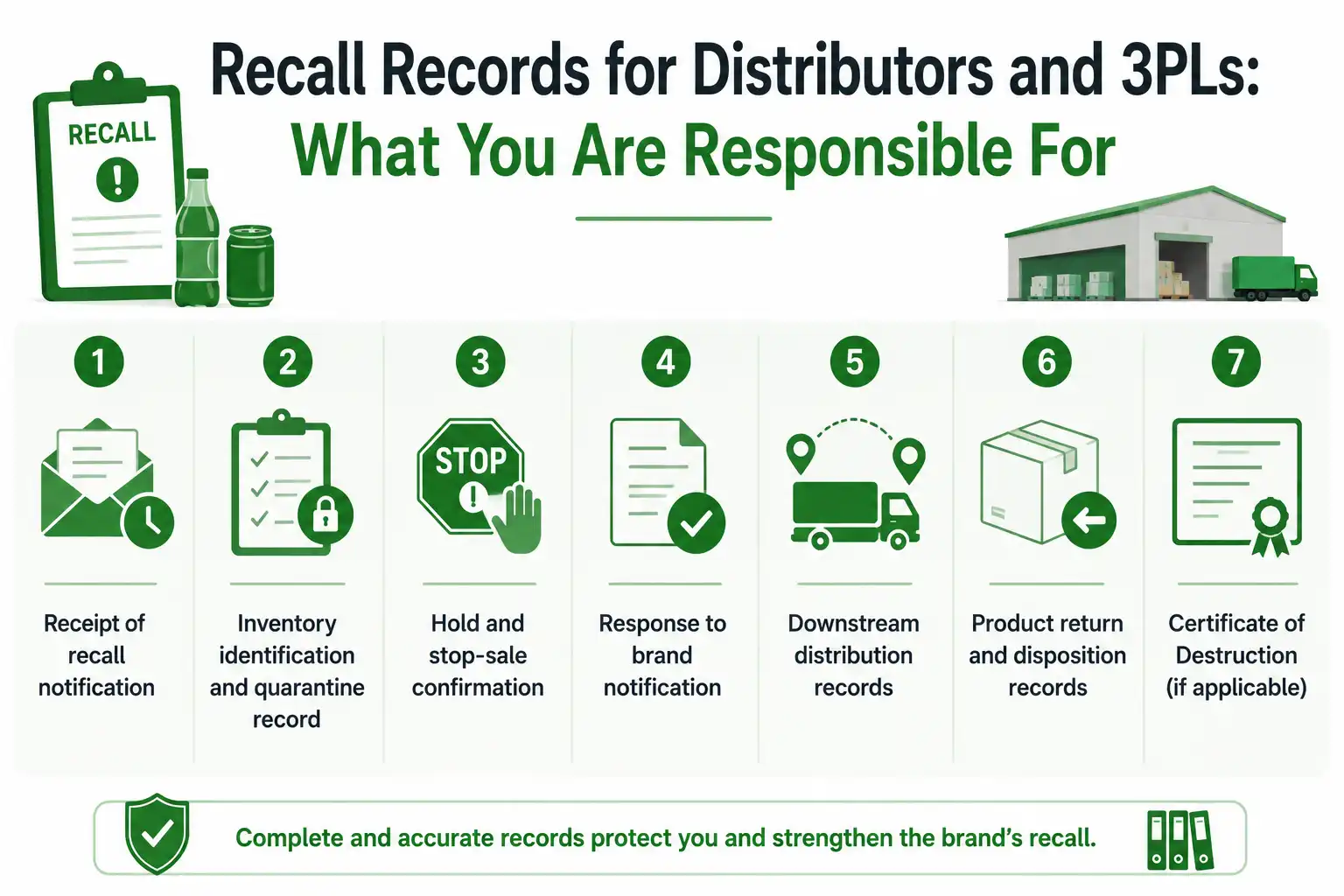
Distributors often underestimate their documentation exposure in a beverage recall. Regulatory bodies can and do request distributor records as part of effectiveness checks. A gap in a distributor’s records becomes a gap in the brand’s recall record. Here is what you are responsible for maintaining:
- Receipt of recall notification – document the date and method you received the notification from the brand; retain the original letter or email with timestamp
- Inventory identification and quarantine record – lot-level records confirming which recalled SKUs are in your facility, in what quantities, and where; document that the product has been physically segregated and is unavailable for further distribution
- Hold and stop-sale confirmation – written record that all affected product has been placed on hold and no further distribution has occurred after receipt of the notification; this is your primary liability protection document
- Response to brand notification – your written confirmation back to the brand that you received the notification, identified the inventory, and placed it on hold
- Downstream distribution records – if you have further distributed the recalled product to secondary accounts, document who received it, in what quantities, and when you notified them; this feeds directly into the brand’s effectiveness check documentation
- Product return and disposition records – documentation of recalled product being returned to the brand or routed to a destruction facility per the brand’s instructions; include quantities, lot numbers, pickup date, and provider information
- Certificate of Destruction (if applicable) – if you are arranging destruction at your facility rather than returning product, ensure you receive a COD from the destruction provider and retain it as part of your recall file
For more on how distributors and 3PLs fit into the broader recall documentation process, the distributors and 3PLs page covers what to expect from an operational standpoint.
The Document That Closes a Beverage Recall: Certificate of Destruction
Every stage of a recall generates records. The COD is the one that closes the record entirely, and without it, the recall stays open regardless of how well everything else was handled.
What a compliant beverage COD must include:
- Product description with lot codes matching the original recall notification
- Exact quantity destroyed: unit count, not volume, for full-container recalled product
- Date of destruction, not date of issue; these can differ
- Method of destruction
- Facility name and location
- Chain of custody reference
- Signed signatory with title
A volume-based record is not sufficient for full-container recalled product. The regulatory body needs lot-level unit count to confirm the specific product identified in the recall has been accounted for.
For alcohol recalls – additional TTB requirements
TTB works with FDA and state Alcohol Beverage Control Boards in every state where the recalled product was distributed, which means the alcohol disposal documentation scope is broader than a standard FDA recall. TTB’s final recall report must cover background and product information, inspection and analysis of the volume of recalled product in the distribution chain, adverse health reports and consumer complaints, corrective action taken, and tax implications for any claims submitted for destroyed product (TTB). Confirm with your TTB contact which fields apply before closing the file.
One thing to confirm before the engagement begins
A COD from an unlicensed or undocumented destruction provider will not satisfy FDA recall termination requirements. Confirm your destruction provider can issue a compliant, audit-ready COD before the product is collected – not after.
For a full breakdown of what a compliant beverage COD must contain, see certificate of destruction for beverage products.
Is Your Documentation Recall-Ready Before a Recall Happens?
The best time to build your beverage recall documentation system is before you need it. The FDA encourages companies to test recall readiness through mock recall exercises; running through the same documentation steps as a real recall using a hypothetical scenario.
The checklist in this article is the foundation for any mock recall. If your team cannot produce each item during a simulation, they will not be able to produce it under the time pressure of a real recall. The gaps a mock recall surfaces are fixable in advance. The same gaps surfacing during an actual recall create liability, slow the process, and damage the supply chain relationships you need intact to resolve it.
FSIS requires official establishments to prepare and maintain written recall procedures under 9 CFR 418.3 before a recall happens, and that pre-recall preparation is exactly what a mock recall tests.
Get Your Recall Documentation Right Before You Need It
Use this table as a quick reference. Print it, save it, or build it into your recall readiness documentation as a responsibility matrix.
|
Document |
Brand |
Distributor / 3PL |
|
Recall decision record |
Required |
Not applicable |
|
Product identification record |
Required |
Required — confirm against inventory |
|
Production and distribution records |
Required |
Required — downstream records |
|
Recall notification letter (sent) |
Required |
Not applicable |
|
Recall notification receipt |
Not applicable |
Required |
|
Downstream notification records |
Not applicable |
Required if product was further distributed |
|
Effectiveness check records |
Required |
Input to brand’s checks |
|
Inventory quarantine / hold record |
Not applicable |
Required |
|
Stop-sale confirmation |
Not applicable |
Required |
|
Product retrieval and return records |
Required |
Required |
|
Recall status reports |
Required |
Not applicable |
|
Consumer complaint / illness reports |
Required |
Forward to brand |
|
Destruction authorization |
Required |
Per brand instructions |
|
Certificate of Destruction |
Required |
Required if distributor arranges destruction |
|
Recall termination confirmation |
Required |
Retain copy |
Record retention reminder: retain all recall records for a minimum of 2 years under FSMA; longer for alcohol recalls, Class I recalls, or any matter with ongoing legal exposure.
Thorough recall documentation is what closes recalls cleanly, limits liability, and keeps supply chain relationships intact. The gaps that slow recalls down are almost always paperwork gaps, and almost always avoidable.
If your recalled inventory needs to be destroyed to close the record, see how our beverage destruction and recycling services for recalled products handle the full process.
Frequently Asked Questions
1. What documentation is required for a beverage recall?
Beverage recall documentation covers four stages: initiation, active management, disposition, and closure. Requirements vary by recall class and regulatory body: FDA, FSIS, or TTB. Treat this checklist as a framework and confirm specifics with your regulatory contact or legal counsel.
2. What is a recall effectiveness check?
A recall effectiveness check verifies that each direct account has been notified, identified the affected product, and is handling it per recall instructions. Brands conduct and document these checks. The regulatory body uses them to assess whether the recall is adequately removing product from commerce.
3. What document closes a beverage recall?
The certificate of destruction closes the product disposition record. It confirms recalled product was permanently destroyed and cannot re-enter the market. Without a compliant COD, the recall record stays open; regulators require verified proof of destruction, not just collection.
4. How long do I need to keep beverage recall records?
FSMA requires food safety records to be retained for a minimum of 2 years. For recall records, retain through the full duration of the recall plus any applicable statute of limitations period. For alcohol recalls with TTB implications, follow TTB and applicable state requirements.
5. What are a distributor’s documentation obligations in a beverage recall?
Distributors must document receipt of the recall notification, quarantine and hold affected inventory, confirm no further distribution occurred, notify any downstream accounts, and document disposition of recalled product. If destruction is required, retain the certificate of destruction as part of your recall file.