An imported food or beverage shipment gets refused at the port. The clock starts immediately. The importer has 90 days to export or destroy the product, and if that deadline passes without action, U.S. Customs and Border Protection can assess liquidated damages against the bond. No extensions. No exceptions.
For importers, warehouse teams, distributors, and beverage brands, imported food beverage destruction is one of the highest-stakes operational scenarios in the supply chain. The decisions made in the days after a refusal notice: who to contact, what documentation to pull, what to do with the product, determine how quickly and cleanly the situation gets resolved.
This guide explains what triggers a destruction requirement for imported food and beverage products, what happens at each stage of the process, and what documentation and logistics questions need to be answered before anything moves. It is not legal advice – importers should confirm specific regulatory requirements with FDA, CBP, a licensed customs broker, or qualified regulatory counsel.
Why Imported Food or Beverage Products May Need to Be Destroyed
Not every held or refused shipment ends in destruction. But several scenarios make it the most likely or only remaining option.
Refused Entry or Import Admissibility Issues
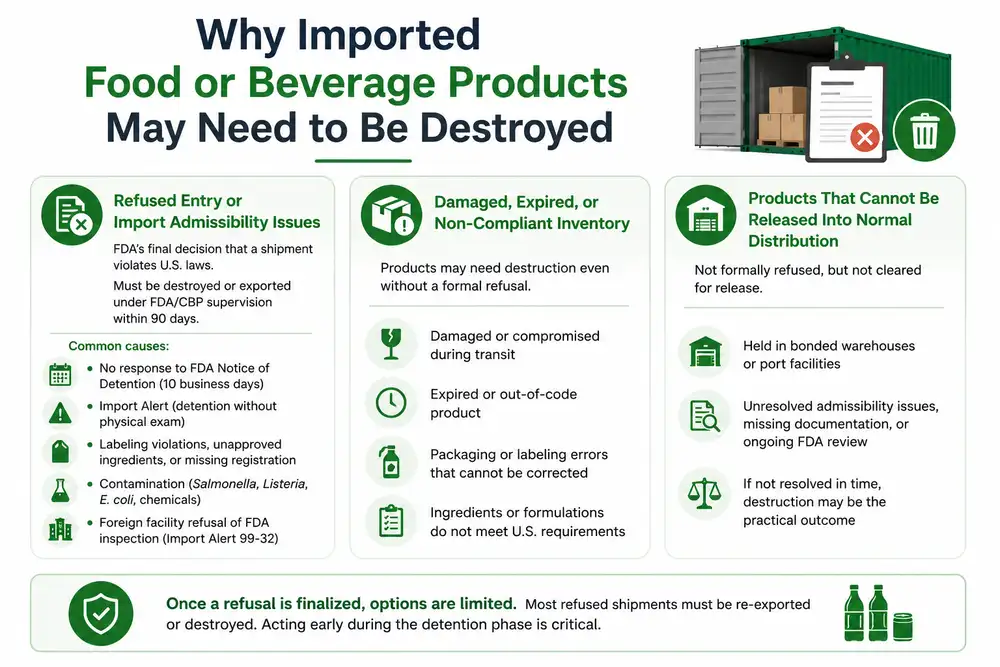
A refusal is FDA’s final decision that a detained shipment is in violation of FDA laws and regulations. A refused shipment must either be destroyed or exported under the supervision of Customs and Border Protection and FDA within 90 days of the date of the Notice of FDA Action (FDA Import Refusals).
Common causes of refusal include:
- Failure to respond to an FDA Notice of Detention within the specified ten business days
- Products subject to an Import Alert; an enforcement action allowing FDA to detain products from specific manufacturers, countries, or product types without physical examination
- Labeling violations, unapproved ingredients, or missing FDA facility registration
- Contamination findings, including Salmonella, Listeria, E. coli, or chemical contamination identified through testing
- Foreign facility refusal of FDA inspection, which can place the manufacturer on Import Alert 99-32 and subject all shipments from that facility to Detention Without Physical Examination
Once a refusal is finalized, options are limited. In rare situations, legal or administrative review may be possible, but most refused shipments must be re-exported or destroyed (https://www.fdaregistrationassistance.com/import-refusal-prevention-fda-detention-help/, 2026). This is why responding correctly during the detention phase, before refusal is finalized, is critical.
Damaged, Expired, or Non-Compliant Inventory
Not all imported food beverage destruction situations stem from formal refusals. Inventory may also need to be destroyed when:
- Product arrives damaged or compromised during transit and cannot be sold or reconditioned
- Shipments contain expired or out-of-code beverage product that cannot enter normal distribution channels
- Packaging or labeling errors are discovered after arrival that cannot be cost-effectively corrected
- Products contain ingredients or formulations that do not meet U.S. requirements
Products That Cannot Be Released Into Normal Distribution
Some imported beverage products sit in bonded warehouses or port facilities in a holding status, not formally refused, but not cleared for release either. Unresolved admissibility issues, missing documentation, or ongoing FDA review can leave products in limbo. If the issue cannot be resolved within the applicable timeframe, destruction may become the practical outcome even without a formal refusal notice.
What Happens After an Import Refusal or Hold?
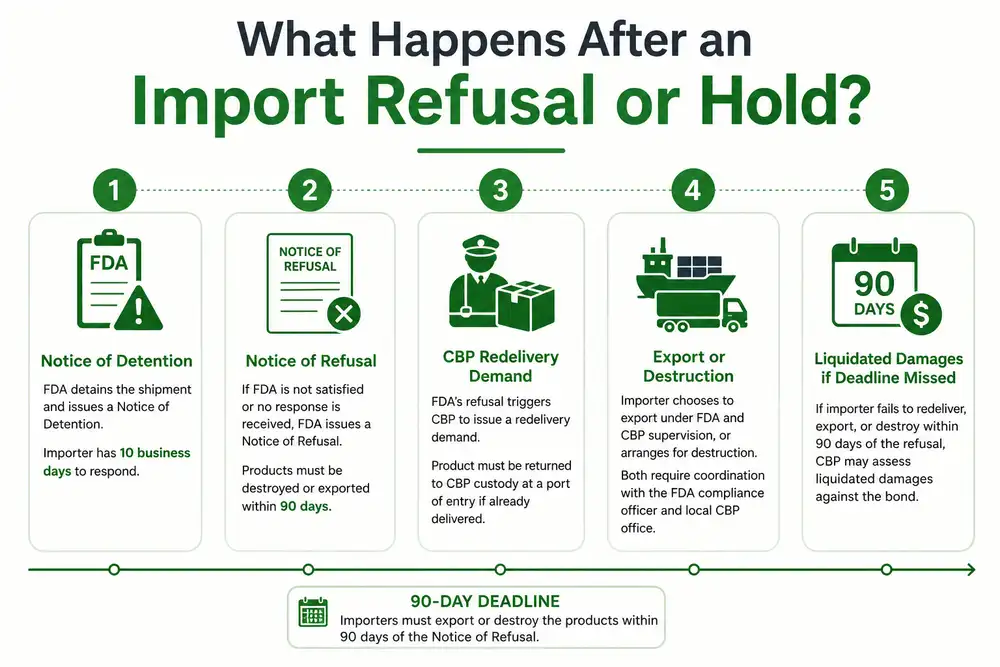
The sequence of events after an FDA refusal moves on a fixed timeline, and understanding it helps importers act rather than react.
- Notice of Detention: FDA detains the shipment and issues a Notice of Detention to the importer and their customs broker. The importer has ten business days to respond with information addressing FDA’s concerns. An extension may be requested, but it is not guaranteed.
- Notice of Refusal: If FDA is not satisfied with the response, or no response is received; FDA issues a Notice of Refusal of Admission. At that point, the products are considered refused, and FDA and Customs will require the importer to destroy or export the products within 90 days of the date of the refusal notice (FDAImports.com, 2023).
- CBP Redelivery Demand: FDA’s refusal triggers CBP to issue a redelivery demand. The product must be returned to CBP custody at a port of entry if it has already been delivered to the importer.
- Export or Destruction: The importer chooses to export the product under FDA and CBP supervision, or arranges for destruction. Both options require coordination with the FDA compliance officer identified on the Notice of FDA Action and the local CBP office.
- Liquidated Damages if Deadline Missed: If the importer fails to redeliver the goods or have them exported or destroyed within 90 days of the refusal, CBP may assess liquidated damages against the bond (FDA Specialist). FDA has no authority to grant extensions beyond the 90-day window.
Export, Reconditioning, or Destruction: What Needs to Be Clarified?
Before committing to a destruction pathway, importers and their customs brokers need to clarify several questions:
|
Question |
Why it matters |
|
Is the product currently under bond or in CBP custody? |
Determines where the product can be moved and who must supervise any action |
|
Has a formal refusal been issued, or is the shipment still detained? |
Detained product may still have reconditioning or export options; refused product does not |
|
Can the product be reconditioned? |
FDA allows labeling corrections and some reconditioning under supervision; confirm with FDA compliance officer |
|
Must destruction be witnessed by FDA and/or CBP? |
It is required that FDA witness the destruction of the product for refused shipments (Certified Laboratories, 2025) |
|
What is the specific destruction method required? |
FDA’s regulations do not require any specific methods for destroying or disposing of refused goods — FDA only requires the goods to be rendered unusable and unsalvageable (FDA Specialist) |
|
Where is the product currently located? |
Port facility, bonded warehouse, importer’s facility, and third-party warehouse all have different logistics and access requirements |
Do not make compliance decisions without confirming these questions with the FDA compliance officer on the notice, your customs broker, or qualified regulatory counsel.
Documentation Businesses Should Organize Before Taking Action
For imported food beverage destruction specifically, documentation is not an afterthought; it is what satisfies the regulatory supervision requirement and confirms the situation has been resolved. Organize the following before any product moves:
Product and shipment records:
- Original import entry documents and entry number
- FDA Notice of Detention and/or Notice of Refusal of Admission
- Product description, lot numbers, batch codes, and UPC codes
- Country of origin, manufacturer name, and supplier documentation
- Pallet count, case count, and weight; verified against shipping documents
Chain-of-custody records:
- Transport records from port or warehouse to destruction facility
- Manifest documenting product handed off for destruction
- Name and location of destruction facility
Destruction records:
- Witness documentation (FDA and/or CBP compliance officer present)
- Weight or volume verification at destruction
- Photos or video evidence of destruction where required
- Certificate of destruction; confirming product was rendered unusable and unsalvageable
For businesses managing beverage destruction and recycling of refused or unsaleable imported product, the documentation chain from intake to certificate is what closes the regulatory record.
Logistics Questions for Warehouses, Importers, and Distributors
Before scheduling any movement of refused or held product, the following logistics questions need answers:
- Where is the product right now? – port facility, bonded warehouse, importer’s DC, or third-party warehouse; each has different access and movement requirements
- Who controls access to the product? – product under bond or CBP custody requires coordination before any movement
- What packaging format is the product in? – bulk liquid, full-container palletized cases, drums, IBCs, or mixed loads each require different transport and handling
- What is the total volume? – pallet count, case count, or liquid volume determines the transport mode (LTL, FTL, vacuum tanker, IBC freight)
- Is the product segregated from other inventory? – refused or held product should be physically segregated and placed on hold to prevent any distribution error
- What is the timeline? – the 90-day window from refusal notice moves faster than most importers expect; storage fees and demurrage charges accumulate in the meantime
For logistics coordination and pickup planning for held or refused beverage inventory, the transportation and logistics coordination page covers how pickup and routing is handled for different inventory types and locations.
Import Destruction Checklist for Food and Beverage Products
Use this checklist before contacting your broker, FDA compliance officer, or a destruction service provider:
|
☐ |
Action Item |
| ☐ |
Confirm the current status of the shipment — detained, refused, held under bond, damaged, or unsaleable |
| ☐ |
Identify which agency, notice, or party is directing the next step — FDA, CBP, or both |
| ☐ |
Confirm the option available — export, reconditioning, or destruction — based on the notice received |
| ☐ |
Document product type, lot numbers, packaging format, pallet/case count, weight, and current location |
| ☐ |
Confirm whether destruction must occur under official supervision and who that supervision comes from |
| ☐ |
Contact your customs broker or regulatory counsel before making compliance decisions |
| ☐ |
Evaluate logistics, transport access, and facility requirements before scheduling any product movement |
| ☐ |
Confirm what documentation you will receive at the end of the destruction process |
When to Involve a Customs Broker, FDA Contact, or Regulatory Counsel
This guide explains the process. It does not replace professional regulatory or legal advice.
Contact the FDA compliance officer identified on the Notice of FDA Action for questions about supervision requirements, acceptable destruction methods, and timeline. Contact your licensed customs broker for questions about bond obligations, CBP redelivery demands, and logistics coordination under CBP custody. Contact qualified regulatory counsel for any situation involving Import Alerts, potential administrative review of a refusal, or complex compliance determinations.
The operational side; reverse logistics, transportation, documentation, and destruction execution; is where a destruction and recycling partner can help. The regulatory and legal side is where FDA, CBP, and qualified professionals take the lead.
How BeverageDestruction.com Can Help With the Operational Side
BeverageDestruction.com, powered by Skip Shapiro Enterprises, supports the operational side of beverage destruction for brands, importers, distributors, and warehouse teams managing unsaleable or non-releasable imported beverage inventory.
That includes:
- Destruction and recycling of eligible packaged and bulk beverage products
- Documentation support: manifests, chain-of-custody records, and certificates of destruction
- Logistics coordination for pickup and transport of held or refused inventory
- PET and beverage packaging recovery where applicable
BeverageDestruction.com does not act as an FDA or CBP regulatory representative. All compliance decisions and supervision requirements should be confirmed with the appropriate regulatory body, customs broker, or counsel before engaging an operational partner.
For questions about beverage destruction documentation, the FAQ covers common questions on what records are produced and how the process works.
Conclusion
Refused and unsaleable imported food and beverage inventory puts importers on a tight timeline with real financial consequences for missing it. Understanding what triggers destruction, what the process requires, and what documentation needs to be in place is what keeps the situation manageable.
If you are evaluating operational options for imported beverage inventory that cannot be sold or released, the beverage destruction and recycling services cover the process for packaged and bulk beverage products.
Frequently Asked Questions
1. What does it mean when imported food or beverage products are refused?
A refusal is FDA’s final determination that a detained shipment violates FDA laws and regulations and cannot enter U.S. commerce. Once refused, the importer has 90 days to export or destroy the product under FDA and CBP supervision. If the deadline is missed, CBP may assess liquidated damages against the bond.
2. Do refused imported products always have to be destroyed?
No. Depending on the situation and the instructions on the notice, export or reconditioning may be options. Exportation sends the product back to the country of origin or another accepting country under supervision. Reconditioning; such as correcting a labeling issue may be permitted in some cases. Confirm the available options with the FDA compliance officer on the notice and your customs broker.
3. Who supervises the destruction of refused imported products?
For formally refused shipments, destruction typically occurs under FDA and CBP supervision. The importer should contact the FDA compliance officer identified on the Notice of FDA Action and the local CBP office for specific supervision requirements. Requirements may vary depending on the product type, location, and instructions provided.
4. What documentation may be needed for imported food beverage destruction?
Documentation typically includes the original import entry and refusal notice, product identification records with lot numbers and packaging details, transport and chain-of-custody records, weight or volume verification, witness documentation, and a certificate of destruction confirming the product was rendered unusable. Confirm specific documentation requirements with the regulatory body and your customs broker.
5. Can beverage products be recycled if they are destroyed?
Potentially, depending on the product type, packaging format, condition, location, and any constraints imposed by the regulatory supervision requirement. For packaged beverage products, PET bottles, aluminum cans, and other packaging materials may have recovery pathways even when the product itself must be destroyed. Confirm with your destruction provider and regulatory contacts what recovery options are available in your specific situation.
6. Who should an importer contact first after receiving a refusal notice?
Contact the customs broker who filed the import entry immediately, and the FDA compliance officer identified on the Notice of FDA Action. For any situation involving legal questions, regulatory review, or Import Alert status, contact qualified regulatory counsel. Do not delay; the 90-day clock begins from the date of the refusal notice.