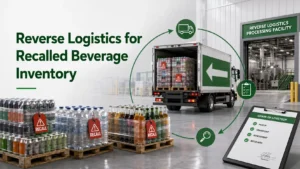
If you searched “certificate of destruction” and landed here after scrolling past articles about paper shredding and hard drive wiping, you are in the right place. That term covers a lot of ground. This article is specifically about beverage products: expired inventory, recalled product, unsaleable stock, and the single document that confirms it was properly handled.
A certificate of destruction (COD) is a formal document issued by a destruction provider confirming that a product has been permanently destroyed, recording what was destroyed, how, when, and by whom. For beverage brands, distributors, and retailers, it is not optional paperwork. It is the document that closes the loop.
The question most people have is not what it is. It is: what should mine actually contain, and will it hold up when I need it?
What Is a Certificate of Destruction?
Start with what it is not. A COD is not a weigh ticket. It is not a pickup receipt. Both of those records indicate that the product was collected and processed. The COD is the final, signed document that confirms destruction is complete and that the product cannot re-enter the market in any form.
In the beverage industry specifically, a COD documents that a defined quantity of product: bottles, cans, kegs, or bulk containers were destroyed at a licensed facility, on a specific date, using a specific method. It does three things at once:
|
Function |
What it means in practice |
|
Legal proof of disposal |
Verifiable record that the product no longer exists and cannot be resold, diverted, or recalled against |
|
Brand protection record |
Confirms unsaleable product was handled properly and cannot resurface in grey markets or unauthorized channels |
|
Compliance documentation |
Satisfies regulatory bodies, retail partner audits, and internal compliance review cycles |
One more thing worth knowing: “certificate of destruction” is a term used across several industries: document shredding, data destruction, and vehicle decommissioning. Beverage product destruction is different. It involves liquid waste handling, depackaging, packaging recovery, and in some cases, regulatory filings with the FDA, USDA, or TTB. A COD from a paper shredding company is not fit for purpose here.
Who Is Actually Qualified to Issue One?
This is a question most brands do not ask until something goes wrong.
Unlike data destruction, where NAID certification is a recognized industry standard, there is no single federal licensing body that certifies beverage destruction providers. Credibility comes from a combination of:
- State environmental and liquid waste handling permits for the processing facility
- Documented chain-of-custody processes from pickup to certificate
- The ability to handle depackaging, liquid disposal, and packaging recovery at scale
- A verifiable track record with beverage-industry clients
A COD is only as credible as the facility behind it. A signed document from an unlicensed or undocumented vendor will not hold up in an FDA recall review, a retail partner audit, or a TTB tax credit claim.
Before engaging any destruction provider, ask for three things: their facility permits, their standard COD template, and references from beverage-industry engagements. If they cannot provide all three, the document they issue carries real audit risk.
For more on how BeverageDestruction.com operates and the standards behind the destruction process, visit us.
What a Certificate of Destruction for Beverage Products Should Include
Some vendors issue a document with four or five fields and call it a certificate of destruction. It looks official. It has a signature. But when an auditor, retail partner, or regulatory body asks follow-up questions, where exactly did destruction take place? What was the lot number? What method was used? The gaps appear fast.
A complete, audit-ready beverage COD has ten fields. Use this as your checklist:
|
Function |
What it means in practice |
|
Legal proof of disposal |
Verifiable record that the product no longer exists and cannot be resold, diverted, or recalled against |
|
Brand protection record |
Confirms unsaleable product was handled properly and cannot resurface in grey markets or unauthorized channels |
|
Compliance documentation |
Satisfies regulatory bodies, retail partner audits, and internal compliance review cycles |
The date of destruction field is worth highlighting. It is the most commonly missing or incorrectly filled field on CODs from smaller vendors and the field most likely to cause problems. The date destruction was completed, and the date the document was issued is not always the same. Recall documentation, TTB filings, and many retail partner requirements all reference the destruction date specifically. If it is not on the COD or if it is wrong, fix it before filing.
When Do You Actually Need a Certificate of Destruction?
Not every brand manager realizes they need a COD until they are already in a situation requiring one. Here are the scenarios where it is not optional:
- Product recall: The FDA’s recall guidance is clear: product disposition must be documented as part of recall termination. The COD is the document that confirms the recalled product was destroyed and prevents it from re-entering the supply chain. Without it, the recall stays technically open, and the brand carries ongoing liability.
- Expired or out-of-code inventory: Distributor and retailer returns of past-date product, slow-moving SKUs, and overstock destruction all generate COD requirements. This is the brand’s documented record that unsaleable product was properly handled, not stored in an unmarked warehouse, not quietly redistributed.
- Retail partner requirements: What was once a best practice is now a contractual requirement at many major chains. If a retail partner has ever asked for “proof of destruction” before crediting a return, a COD is exactly what they mean. Some retailers have their own required COD format; worth confirming before any engagement begins.
- Brand protection: Unauthorized resale of discounted or unsaleable product is a real risk. Once a product leaves your facility without documentation, there is no way to prove it was destroyed if it resurfaces in grey markets, dollar-store channels, or unauthorized online listings.
- Insurance claims: Spoilage, product loss, and recall-related insurance claims often require documented proof of disposition. Without a COD, claims can be delayed or reduced.
- Internal compliance and audits: Many brands have internal destruction policies requiring documentation regardless of external regulations. The COD closes the record for QA teams and internal audit cycles.
- Alcohol-specific regulatory requirements: For alcohol products destroyed to claim federal excise tax credits, documentation must meet TTB standards. TTB Form 5620.8 governs these claims, and for beer, wine, or spirits, claims must be filed within 6 months of the date of destruction. The COD supports this process, but requirements vary by product type and state. More detail on alcohol documentation is covered in the alcohol destruction tax compliance resource.
What the Certificate of Destruction Process Looks Like End to End
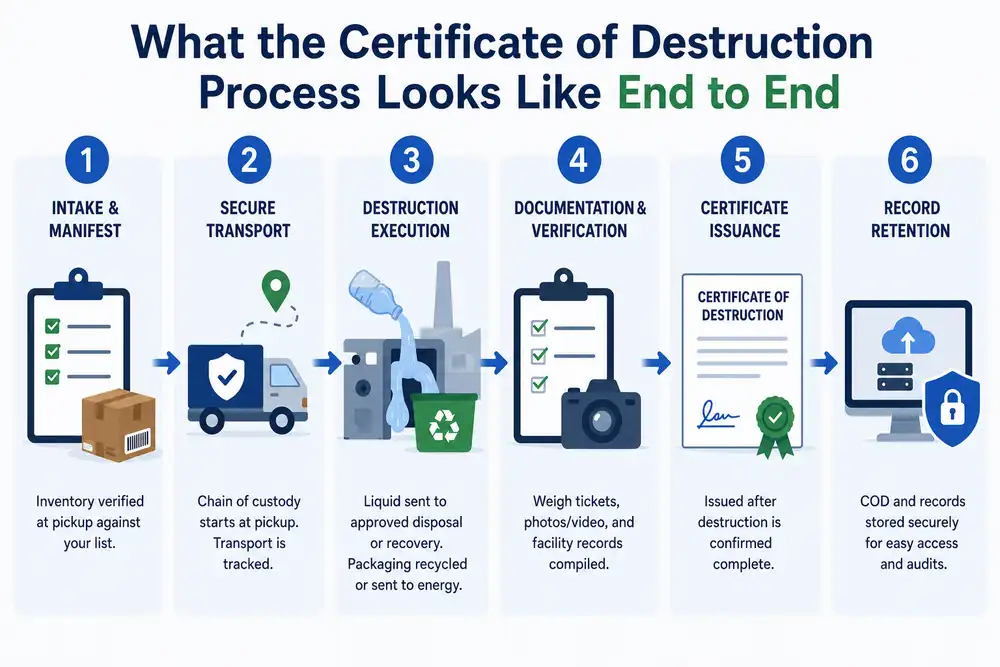
The COD is only as reliable as the process that produced it. It is not a form filled out on request; it is the final record of a documented, verifiable sequence of events. Here is what that sequence looks like:
- Step 1 – Intake and manifest: Product is inventoried at pickup. Quantities, SKUs, and lot numbers are confirmed against your inventory list. This manifest is what the COD will eventually close out. Any discrepancy is much easier to catch here than after the engagement has closed.
- Step 2 – Secure transport: Chain of custody; the unbroken, documented record of who held the product at every point in the process begins the moment pickup happens. Transport to the processing facility is tracked and recorded.
- Step 3 – Destruction execution: Depackaging separates the liquid from the packaging. The liquid is routed to an approved disposal or recovery pathway: anaerobic digestion, permitted wastewater treatment, or recovery for reuse, depending on the product type. Packaging is separated for recycling or waste-to-energy processing.
- Step 4 – Documentation and verification: Weigh tickets, photo and video evidence, and facility records are compiled. Some engagements include on-site witnessing by the client or a third-party standard practice for retail partner COD requirements, and some regulatory filings.
- Step 5 – Certificate issuance: The COD is issued after destruction is confirmed complete. It references the intake manifest, facility name and location, date of destruction, method used, and the signatory responsible for certification.
- Step 6 – Record retention: The COD goes into a centralized, accessible records system. For recall terminations and audits, having organized, retrievable documentation is what separates a clean resolution from a drawn-out one.
BeverageDestruction.com, powered by Skip Shapiro Enterprises, provides certificates of destruction as a standard deliverable on every engagement: full-container packaged product, bulk inventory, and alcohol-containing beverages included. Learn more about certified beverage destruction and recycling services.
Certificate of Destruction vs. Certificate of Recycling: What’s the Difference?
Most brands learn this distinction when they need both documents and only have one.
When depackaging separates liquid from packaging, two material streams are created. Each gets documented differently:
|
Document |
What it confirms |
When you need it |
|
Certificate of Destruction (COD) |
Product was permanently destroyed and cannot re-enter the market |
Recall compliance, retail partner requirements, brand protection, insurance claims, regulatory filings |
|
Certificate of Recycling (COR) |
Materials from the destruction were diverted to a recycling or recovery stream, not landfilled |
ESG reporting, retailer sustainability requirements, internal environmental goals |
They are not interchangeable. The COD closes the compliance record. The COR documents the sustainability outcome.
For beverage products, a complete documentation package often includes both. The COD confirms the product is gone. The COR confirms that the PET bottles, aluminum cans, or glass were recovered rather than buried.
Some providers issue a combined document. Others issue them separately. Clarify which format you will receive, and whether it meets your retail partner or regulatory requirements; before the engagement begins, not after.
For brands where packaging recovery is part of the picture, the PET plastic recycling for beverage packaging process covers what happens to the material after the product is destroyed.
How to Evaluate a Certificate of Destruction Before You File It
Receiving a COD is not the same as having a usable one. Before that document goes into your records, run through this checklist; it takes five minutes, and it is significantly easier to fix gaps now than after the engagement has closed.
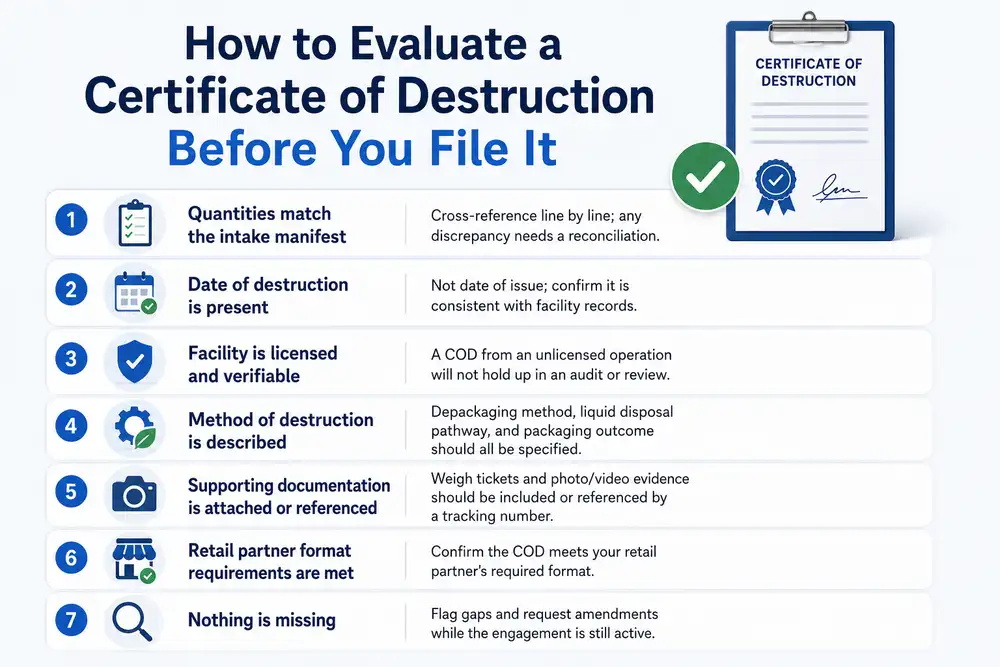
- Quantities match the intake manifest – cross-reference line by line; any discrepancy needs a reconciliation before filing.
- Date of destruction is present – not date of issue; confirm it is consistent with the facility’s records.
- Facility is licensed and verifiable – a COD from an unlicensed operation will not hold up in an audit or recall review.
- Method of destruction is described – “product destroyed” is not sufficient; depackaging method, liquid disposal pathway, and packaging outcome should all be specified.
- Supporting documentation is attached or referenced – weigh tickets and photo or video evidence should be included or referenced by a retrievable tracking number; a COD without supporting records is a statement, not proof.
- Retail partner format requirements are met – if the COD is intended to satisfy a retail partner audit or return credit, confirm their required format was followed.
- Nothing is missing – flag gaps and request amendments while the engagement is still active; corrections get harder once the provider has moved on.
What Happens If You Don’t Have One?
Let’s be direct: the absence of a COD is not a paperwork gap. It is a liability gap. Here is what that looks like in practice:
- Recall stays open – without a COD, an FDA or USDA recall cannot be formally terminated; the brand carries ongoing regulatory liability until the record is closed with verified destruction documentation.
- Retail partner non-compliance – retailers requiring a COD as a condition of return credits or shelf removals will not process without one; the brand loses that channel or fails the supplier audit
- Audit failure – internal QA, third-party brand, and retailer supplier audits all check for destruction records; one missing COD raises questions about the entire destruction program
- Gray market exposure – undocumented disposal leaves a chain-of-custody gap that cannot be closed retroactively; if the product resurfaces in unauthorized channels, there is no proof it was legitimately destroyed.
- Alcohol tax credit disqualification – excise tax credit claims for destroyed alcohol require documentation meeting TTB standards; informal disposal without records disqualifies the claim entirely, and the 6-month filing window does not pause while you look for paperwork
- For alcohol-specific documentation requirements, the alcohol destruction tax compliance page covers what TTB and state regulators require.
Frequently Asked Questions
1. What is a certificate of destruction?
A certificate of destruction is a formal document issued by a destruction service provider confirming that a specific product has been permanently destroyed. It records what was destroyed, how, when, where, and by whom, creating a verifiable audit trail for compliance, regulatory, and brand protection purposes. In the beverage industry, it is the primary document confirming that unsaleable, recalled, or expired product has been properly handled and cannot re-enter the market.
2. What should a certificate of destruction for beverage products include?
A complete beverage COD should include the client name, product description with lot or batch codes, exact quantity destroyed, date of destruction, method of destruction, facility name and location, chain of custody reference, and a signed signatory with title. Supporting documentation, such as weigh tickets or photo evidence, should be attached or referenced. A COD missing any of these fields may not hold up in an audit or recall review.
3. When do you need a certificate of destruction for beverages?
A COD is required for recalled product documented for FDA or regulatory closure, for expired or unsaleable inventory where a retail partner or brand policy requires documented disposal, and for any destruction engagement where the brand needs verifiable proof that product cannot be resold or diverted. It is also required for alcohol excise tax credit claims, with TTB requiring filings within 6 months of the date of destruction.
4. Is a certificate of destruction the same as a weigh ticket?
No, and the distinction matters. A weigh ticket records the weight of product collected or processed at a facility. A COD confirms that destruction is complete and documents the method, date, and responsible party. A complete documentation package includes both: the weigh ticket supports the quantity record, and the COD confirms the destruction event.
5. How long should I keep a certificate of destruction?
For recalled products, retain records for as long as the recall record is open, plus any applicable statute of limitations period after closure. For routine unsaleable inventory destruction, most brands retain CODs for 3-7 years in line with their general document retention policy. For alcohol-related destruction with tax implications, retain records in line with TTB and applicable state requirements.